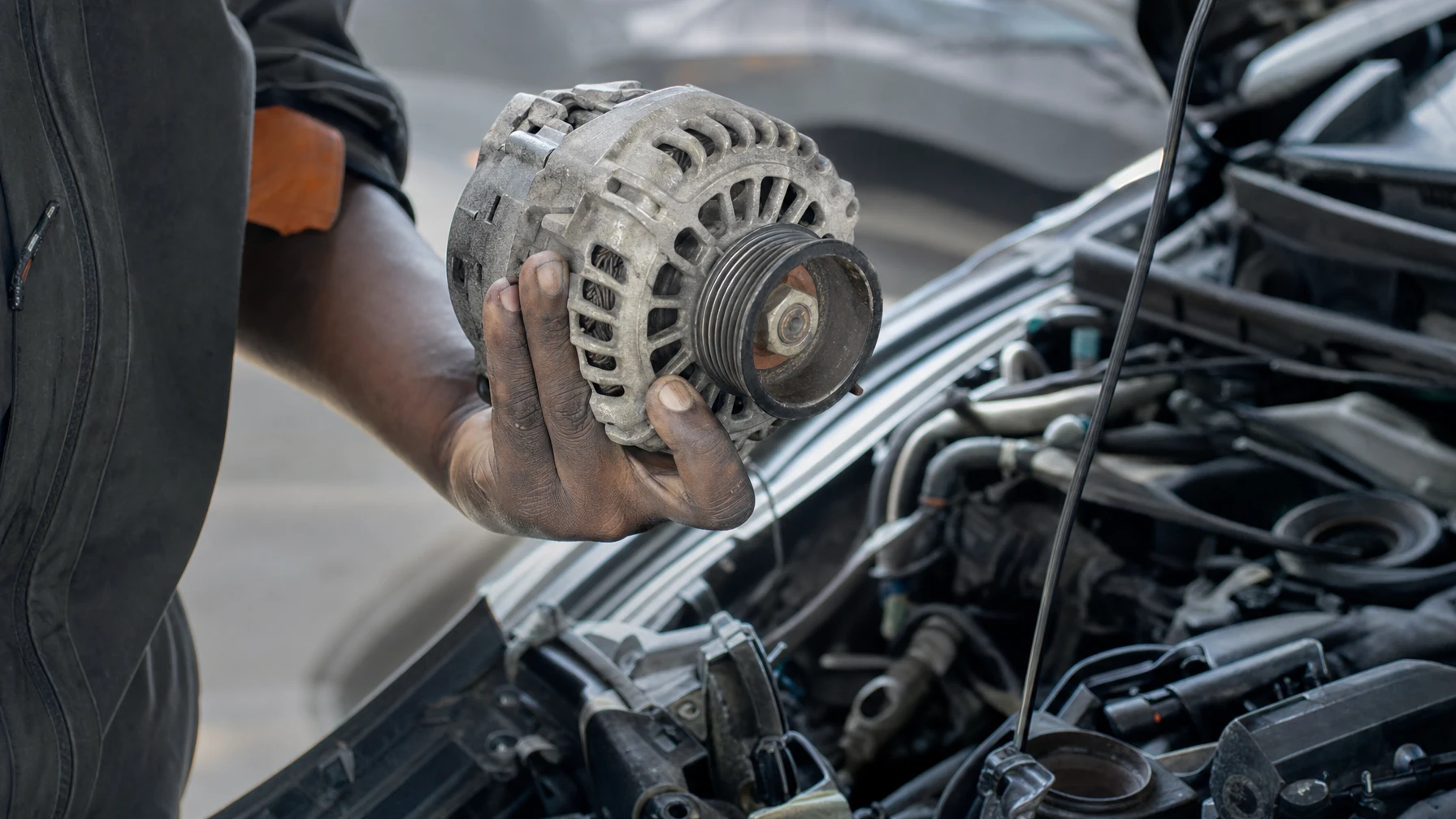
If your alternator is failing, the next question is always the same: what’s this going to cost? Here’s a straight breakdown of alternator replacement cost — Big Tee’s labor pricing, what moves it, and how to make sure you’re actually paying to fix the right thing.
How Much Does an Alternator Replacement Cost?
Alternator replacement is priced as labor — you supply the part, or Big Tee can source it at actual cost with no markup. Economy cars with an easy-to-reach alternator take less labor; many luxury and European models — or engines where the alternator is buried — take longer.
As always, the only truly accurate number comes after a diagnosis confirms the alternator is the problem (and not the battery or the belt). Big Tee’s approach is to test first, then quote the labor in writing, and much of this can be done as a mobile mechanic job right where the car sits.
What Affects Alternator Replacement Cost
Three things move the total:
- The part you choose. Alternator cost varies a lot by make, model, and amperage. New, remanufactured, and OEM-vs-aftermarket all affect what you pay for it.
- Labor to reach it. On some cars the alternator is right on top; on others, you’re removing components to get to it. More labor, higher bill.
- Your vehicle. Foreign and European cars typically cost more — both the part and the labor to install it — than common domestic models.
Want a real alternator quote, not a guess? Call or text Big Tee at (770) 780-0730 — we test the charging system and quote in writing.
New, Remanufactured, or Aftermarket?
This choice affects both what you pay for the part and how long the replacement lasts, and since you’re the one sourcing it, it’s worth understanding. A new OEM alternator costs the most but comes with the tightest quality control. A remanufactured alternator, a used core rebuilt to spec with new bearings, brushes, and often a new regulator, typically runs noticeably less than new while still carrying a warranty, and it’s a solid middle ground for most drivers. Aftermarket alternators are the cheapest option, but quality varies a lot by brand, and a bargain unit that fails again in a year isn’t actually the cheap choice once you count the second round of labor. The part itself is one line item; how long it actually lasts is the number that matters more.
Alternator Belt Replacement Cost
Sometimes the charging problem isn’t the alternator at all — it’s the belt that drives it. A worn, glazed, or loose serpentine/alternator belt can cause undercharging and noise. The good news: a belt is a much smaller part than the alternator, and the labor to swap it is a fraction of the bigger job. This is exactly why diagnosing first saves money — you don’t want to buy an alternator when a belt was the issue.
Why Some Alternators Take Twice the Labor
The “labor to reach it” factor is worth unpacking, because it explains a lot of the price spread between vehicles. On some engines the alternator sits right up top, bolted where a wrench reaches it directly, and swapping it is a straightforward hour or so. On others, especially transverse-mounted engines in tight engine bays, the alternator ends up buried behind the intake manifold, a motor mount, or other components that have to come off first just to get a socket on the alternator’s bolts. That difference alone can turn a one-hour job into a three- or four-hour one, on the exact same part, which is why two shops quoting the same brand of alternator can land on very different totals.
Repair vs. Replace an Alternator
For a failed alternator, replacement is almost always the move — rebuilding one rarely makes financial sense versus a quality new or remanufactured unit. The real “repair vs. replace” decision is usually about the part (new vs. reman) and confirming it’s the alternator and not the battery. Speaking of which…
What a Warranty Should Actually Cover
Ask what the warranty covers before you agree to a price, not after. A meaningful alternator warranty covers the part itself against failure for a real stretch of time, often a year or more on a quality remanufactured unit, and separately, the labor to put a warranty replacement back in should the first one fail early. A warranty on the part alone, with no labor coverage, is a much weaker promise, since a failed alternator under a parts-only warranty still means paying for the removal and installation labor twice. It’s worth asking the question directly rather than assuming “it’s under warranty” covers everything it sounds like it does.
How to Know It’s Actually the Alternator
Before you pay for an alternator, make sure that’s the problem. A quick charging-system test checks battery health, alternator output, and the belt. If a jump start gets you going but the car dies again, that points to the alternator; if it holds a charge, it’s likely the battery. And if the car cranks fine but simply won’t turn over at all, that’s a different part doing the failing — see bad starter symptoms for that side of it.
Most alternator work can be done in Decatur and Metro Atlanta — diagnosed and replaced right where your car sits, with no tow and no dealer markup.
Written by the Big Tee Auto Repair team — 29 years of mobile and shop mechanic experience in Decatur, GA and Metro Atlanta.