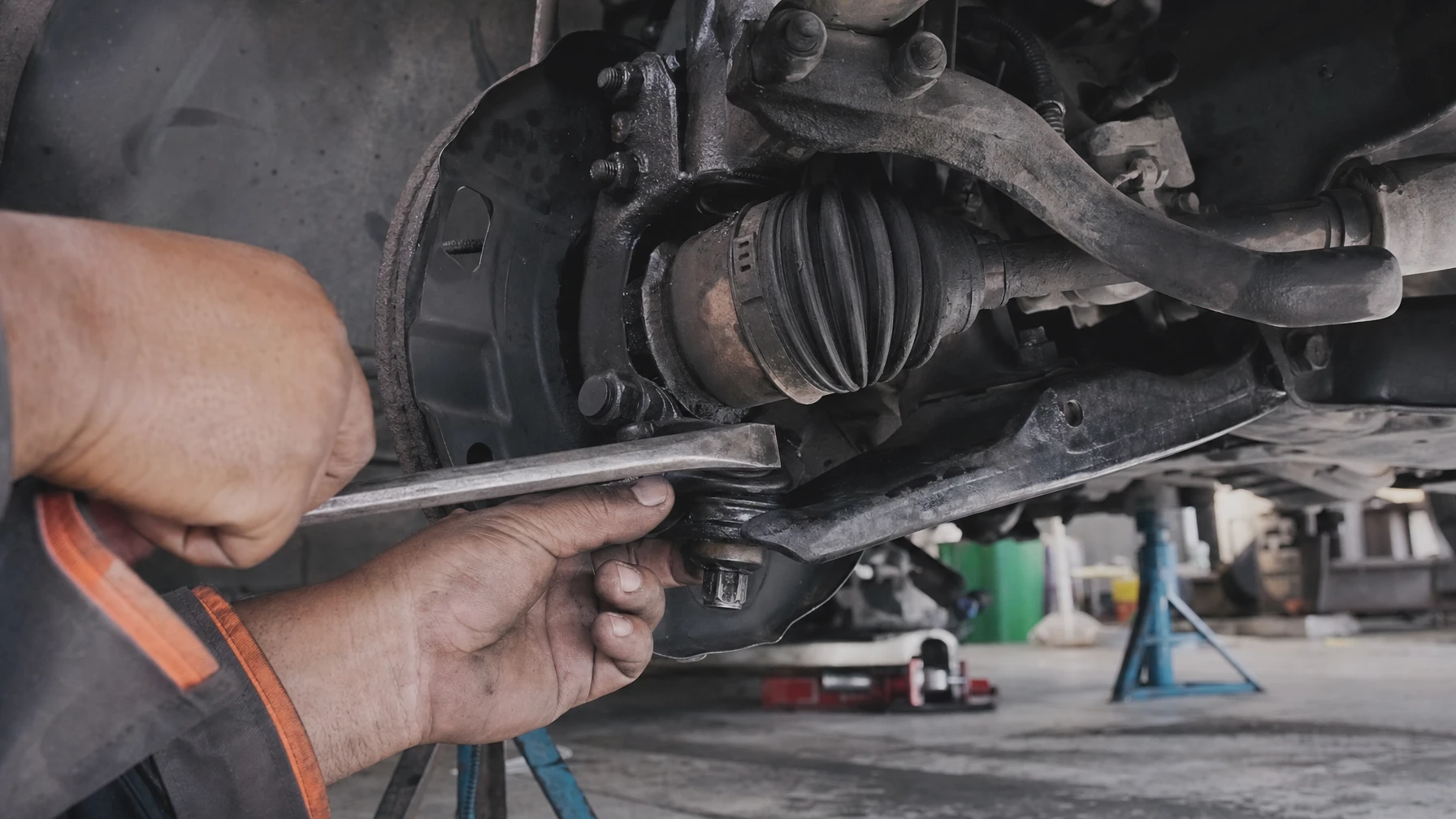
A clunk over every bump and steering that feels loose or wandering — those are the classic signs of a worn ball joint. It’s a small part doing a critical job, which is why a bad one is a safety repair, not a “deal with it later” one. Here’s what ball joint replacement costs, how to spot a failing one, and why it matters so much.
Ball Joint Replacement Cost
Ball joint work is priced as labor, the same as the rest of Big Tee’s suspension repair — you supply the part, or Big Tee can source it at actual cost with no markup, and the labor total is confirmed in writing once the front end is inspected. What moves the labor time:
| Factor | Effect on labor |
|---|---|
| Upper vs. lower joint | Lowers often carry more load/labor |
| Bolt-on vs. pressed-in | Pressed-in takes more labor |
| Integrated into control arm | Whole arm replaced — more labor |
| Your vehicle | Make, model, and front-end design |
The key variable is how the joint mounts. Some are simple bolt-on parts; others are pressed into the steering knuckle or control arm and take more labor (sometimes a press). And on a lot of vehicles the ball joint is built into the control arm, so the whole arm gets replaced as a unit — more labor than a standalone joint. An inspection tells you which setup your car has, and whether other front-end parts are worn too, since these tend to go together.
Hearing a clunk over bumps or feeling loose steering? Call or text Big Tee at (770) 780-0730 — the front end is no place to guess. We'll inspect and quote it straight.
Signs of a Bad Ball Joint
Clunking or Knocking Over Bumps
The most common symptom. A worn ball joint has play in it, so going over bumps or rough pavement produces a clunk or knock, usually from the front of the car. It often gets worse over time.
Loose, Wandering Steering
A bad ball joint makes the steering feel vague or wandering — the car doesn’t track straight as confidently, and you find yourself making small corrections. The front end can feel “loose.”
Uneven Tire Wear
Excess play changes the wheel’s alignment angles, causing uneven wear on the inner or outer edge of the tire. Catching it early can save a set of tires.
Vibration Through the Steering Wheel
Like other worn front-end parts, a bad ball joint can transmit vibration through the steering — one of several possible causes of a shake, worth ruling out alongside tire balance and wheel bearings.
Why a Bad Ball Joint Is Dangerous
This is the part to take seriously. The ball joint is what connects your steering knuckle to the control arm — it’s a primary link holding the wheel to the car while letting it pivot and move. If a severely worn joint separates, the suspension collapses and the wheel folds under the car. At any speed, that’s a serious loss of control. A clunking ball joint is your warning to act before it gets to that point.
The Honest Approach
Big Tee inspects the whole front end — ball joints, control arm bushings, tie rods, and wheel bearings — because these parts wear together and the symptoms overlap. That way you replace exactly what’s worn, not a guess. Much of it can happen right in your driveway across Decatur and Metro Atlanta, with a written quote before anything is touched.
A clunk in the front end is the car asking for an inspection. On a safety part like this, that’s an easy yes.
Written by the Big Tee Auto Repair team — 29 years of mobile and shop mechanic experience in Decatur, GA and Metro Atlanta.