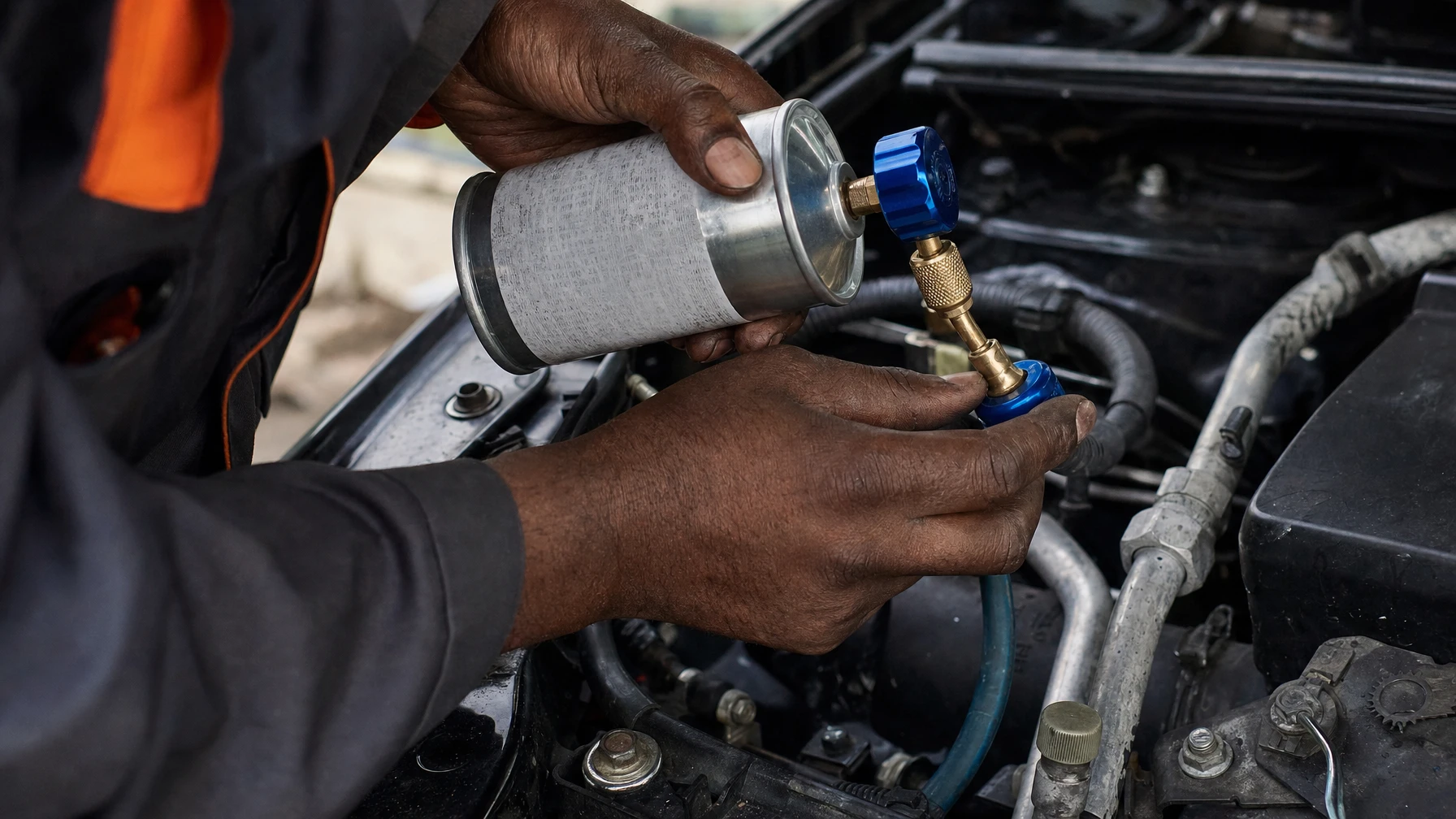
If your car AC is blowing warm in a Georgia summer, “it just needs a recharge” is the first thing most people hear, and it’s the most misunderstood repair in the business. So let’s answer the money question first, then the one that actually saves you money.
Other shops typically charge $150–$300 for a recharge, bundled; a DIY kit runs $30–$60. Big Tee prices it as labor instead: starting at $75, with refrigerant billed separately at actual cost. But the real answer is: a recharge by itself is usually a band-aid, and here’s why.
Car AC Recharge Cost: Shop vs. DIY vs. Big Tee
| Option | Typical cost | What you actually get |
|---|---|---|
| DIY recharge kit | $30–$60 | Refrigerant added; no leak check; overcharge risk |
| Other shops (R-134a), bundled | $150–$250 | Proper evacuate + recharge to spec |
| Other shops (R-1234yf), bundled | $200–$300+ | Same, but newer refrigerant costs more |
| Big Tee: labor + leak diagnosis | $75+ labor, refrigerant at cost | The actual fix, not a refill |
Two things move the total: which refrigerant your car uses and how the recharge is done. Vehicles built roughly 2015 and newer often use R-1234yf, which costs significantly more per can than the older R-134a — that’s true either way, a shop’s bundled price or Big Tee sourcing it at cost. And a proper recharge, the kind that’s genuinely part of car AC repair rather than a parking-lot top-off, does more than “add a can”: the system is evacuated, vacuum-tested, and refilled to the exact factory spec by weight.
Blowing warm in Atlanta traffic? Call or text Big Tee at (770) 780-0730 — we'll find out if a recharge is even the right fix before you pay for one.
Why a Recharge Alone Is Usually a Band-Aid
Here’s the part the quick-lube places skip: your AC system is sealed. It doesn’t burn refrigerant the way an engine burns oil. So if your refrigerant is low enough that the AC blows warm, the refrigerant went somewhere — and that means a leak.
When you pay for a recharge without fixing the leak, you’re refilling a system that’s going to empty itself again. Sometimes that’s a few months; with a bigger leak it’s a few weeks. You stay cold just long enough to think it’s fixed, then you’re back to warm air and another bill. That’s because low refrigerant is a symptom, not the disease.
Where AC Refrigerant Leaks From
- O-rings and seals — they dry out and shrink with age
- The condenser — up front, exposed to road debris and corrosion
- Hoses and fittings — rubber lines crack over time
- The compressor — front seal weeps refrigerant as it wears
- The evaporator — inside the dash; the hardest and priciest leak to reach
The Hidden Risk of DIY Recharge Kits
The $40 kit at the parts store is tempting, but it has three real downsides:
- Overcharging. The gauges on cheap kits are inaccurate, and too much refrigerant raises system pressure — which can damage the compressor (a far more expensive part than a recharge).
- Sealant. Many “stop leak” recharge cans contain sealant that can gum up the AC components and the recovery equipment a shop later needs to use — sometimes turning a cheap repair into an expensive one.
- It still doesn’t fix the leak. You’re back where you started, minus $40.
For a one-time “I have to get through this week” moment, a kit can buy you a few cold days. As an actual repair strategy, it usually costs more down the road.
The Honest Approach: Test First, Then Recharge
Big Tee does AC the other way around: test the system to find why it’s low — a leak, a tired compressor, or an electrical issue — and you get a written quote before anything is touched. If a simple recharge is genuinely all it needs, great. If there’s a leak, you find out before you’ve paid to refill it twice.
A lot of this happens right in your driveway across Decatur and Metro Atlanta — no hot waiting room while your car bakes in a shop lot.
Bottom line: Big Tee’s own recharge labor starts at $75 — but the number that actually matters is “why is it low in the first place,” not “how much to recharge it.” Answer that once, and you stop paying for the same cold air every summer.
Written by the Big Tee Auto Repair team — 29 years of mobile and shop mechanic experience in Decatur, GA and Metro Atlanta.