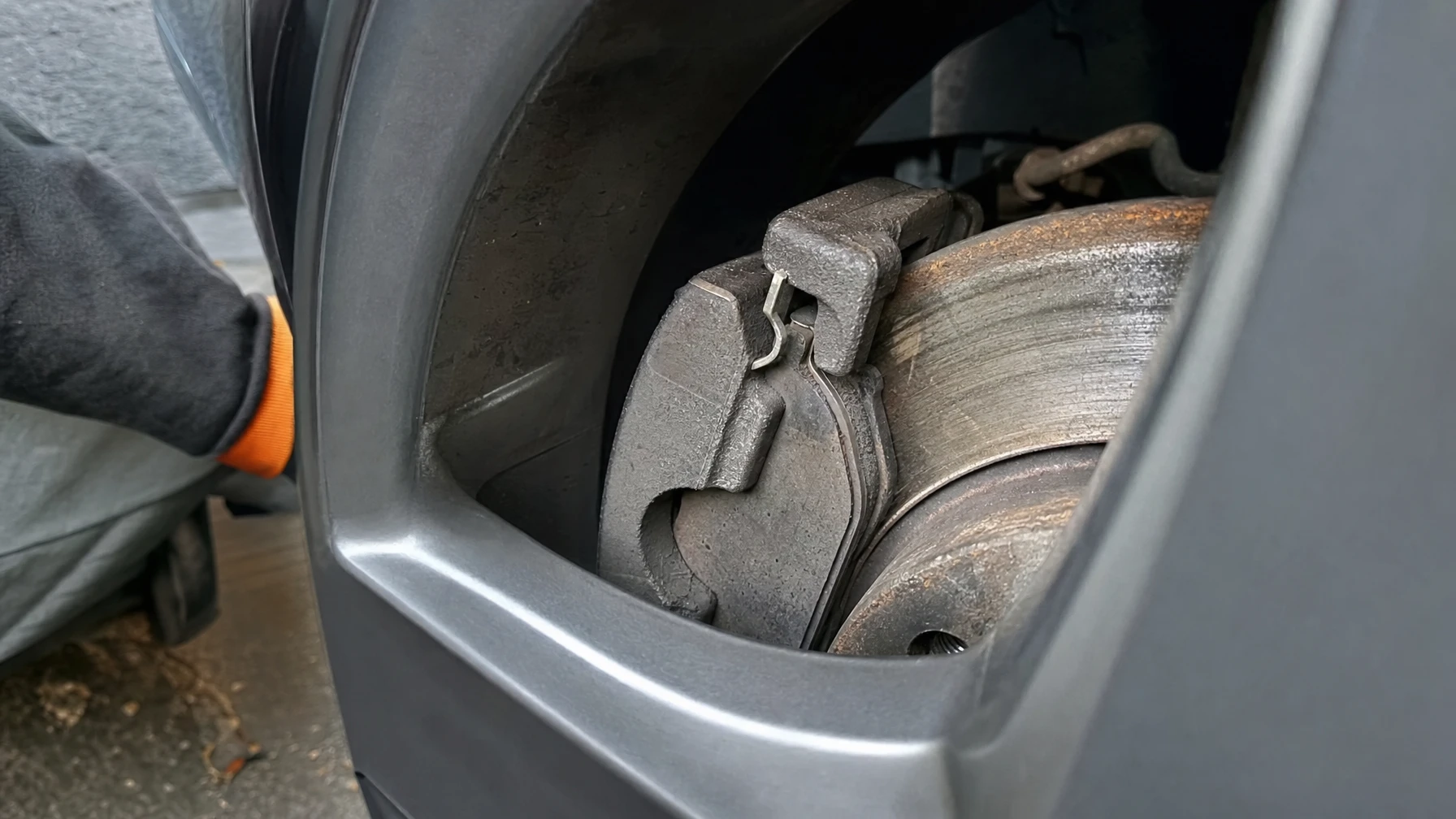
Brakes are the one system on your car where catching wear early doesn’t just save money — it keeps you safe. The good news is you don’t need to be a mechanic to get a rough sense of where your brake pads stand. Here’s how to check them, how long they should last, and the point where worn pads start damaging the much pricier parts behind them.
How to Check Your Brake Pads
You can get a decent read in a few minutes:
- Look through the wheel spokes. On most cars you can see the brake pad pressed against the shiny metal rotor. Estimate the thickness of the pad material.
- Judge the thickness. More than about 1/4 inch (3mm) of pad is generally fine. Down around 1/8 inch (3mm or less) means replacement is coming soon.
- Listen. A high-pitched squeal when you brake is often the built-in wear indicator — a small metal tab designed to squeal when pads get low.
- For the full picture, pull the wheel. A complete inspection means removing the wheel to see all the pads (inner and outer) and the condition of the rotors — that’s the part a mechanic does.
If you hear a squeal, our guide on why your brakes are squeaking breaks down what that noise is actually telling you.
That method works for the disc brakes on the front of nearly every car, and often the rear too. Some vehicles, mostly older or budget models, still use rear drum brakes instead of disc brakes in back, and you can’t eyeball those through the wheel the same way. A drum hides the actual brake shoes behind a solid metal housing, so checking them means pulling the drum off, which is a job for a mechanic rather than a driveway glance. If your rear wheel shows a solid drum instead of a rotor with a caliper clamped around it, that’s the tell.
For the full picture — parts, pricing, and what’s included — see brake repair in Decatur.
How Long Do Brake Pads Last?
Most brake pads last 30,000 to 70,000 miles — a wide range, because wear depends heavily on how and where you drive:
- City stop-and-go wears pads faster than steady highway miles.
- Hills and heavy loads (towing, a full vehicle) increase wear.
- Front pads wear faster than rear, because the front brakes do most of the stopping.
- Driving style matters — hard, late braking eats pads quickly.
So mileage is a guide, not a guarantee. The actual condition of the pad is what counts, which is why a periodic look matters more than a number.
Not sure how much brake life you've got left? Call or text Big Tee at (770) 780-0730 — we'll inspect the pads and rotors and give you a straight answer.
Signs Your Brake Pads Are Worn Out
- A high-pitched squeal when braking — the wear indicator doing its job
- Thin pad material when you look through the wheel
- Longer stopping distances or a brake pedal that needs more effort
- Vibration or pulsing when braking — often a rotor issue developing
- A grinding noise — the serious one (see below)
Does the Type of Brake Pad Change How It Wears?
Somewhat, yes, and it’s worth knowing what’s on your car when you’re comparing replacement quotes. Ceramic pads are the common choice on most passenger cars today: they run quieter, produce less of the dark dust that coats a wheel, and tend to be gentler on rotors, though they usually cost more up front. Semi-metallic pads, built with metal fibers mixed into the friction material, handle heat better under hard or repeated braking, which is why they show up more on trucks, performance cars, and vehicles that tow, but they’re noisier and wear rotors faster. Organic pads are the softest and quietest of the three but wear out the fastest, so they’re less common now than they used to be. None of that changes how you check them; it changes how long you can expect a set to last and what you’ll notice while they’re wearing.
When Worn Pads Start Costing You Rotors
This is the part that matters most for your wallet. Brake pads are designed to wear out — they’re the cheap, sacrificial part. But if you ignore worn pads until you hear grinding, the pad material is gone and metal backing is digging into the rotor. Now you’re not replacing $50 worth of pads; you’re replacing or resurfacing rotors too, which is why our brake pad and rotor replacement cost breakdown jumps so much once rotors are involved.
That’s the whole case for checking early: pads caught in time are a cheap, routine job. Pads ignored into grinding turn into a much bigger bill — and a real safety risk in between.
The Honest Approach
A full inspection covers more than pad thickness. Rotors get checked for scoring (grooves cut by worn-out pads), thickness against the minimum stamped on the rotor itself, and warping, which shows up as a pulsing pedal or shudder under braking. Calipers get checked too, since a caliper that’s sticking or not releasing fully wears one pad faster than its opposite number and can drag enough to overheat a wheel. Big Tee inspects brakes the right way — a real look at pads and rotors, with an honest read on how much life is left rather than a push to replace parts that are fine. A lot of it happens right in your driveway as a mobile mechanic in Decatur serving Metro Atlanta. And if it’s been a while on the brake fluid too, we’ll flag that, since fresh fluid is part of a healthy brake system.
Check your pads before they check your rotors. It’s the cheapest brake decision you’ll make.
Written by the Big Tee Auto Repair team — 29 years of mobile and shop mechanic experience in Decatur, GA and Metro Atlanta.