If your starter has failed, the next question is the cost. Here’s a straight breakdown of starter replacement cost — Big Tee’s labor pricing, what moves it, and how to make sure you’re actually paying to fix the right part.
How Much Does a Starter Replacement Cost?
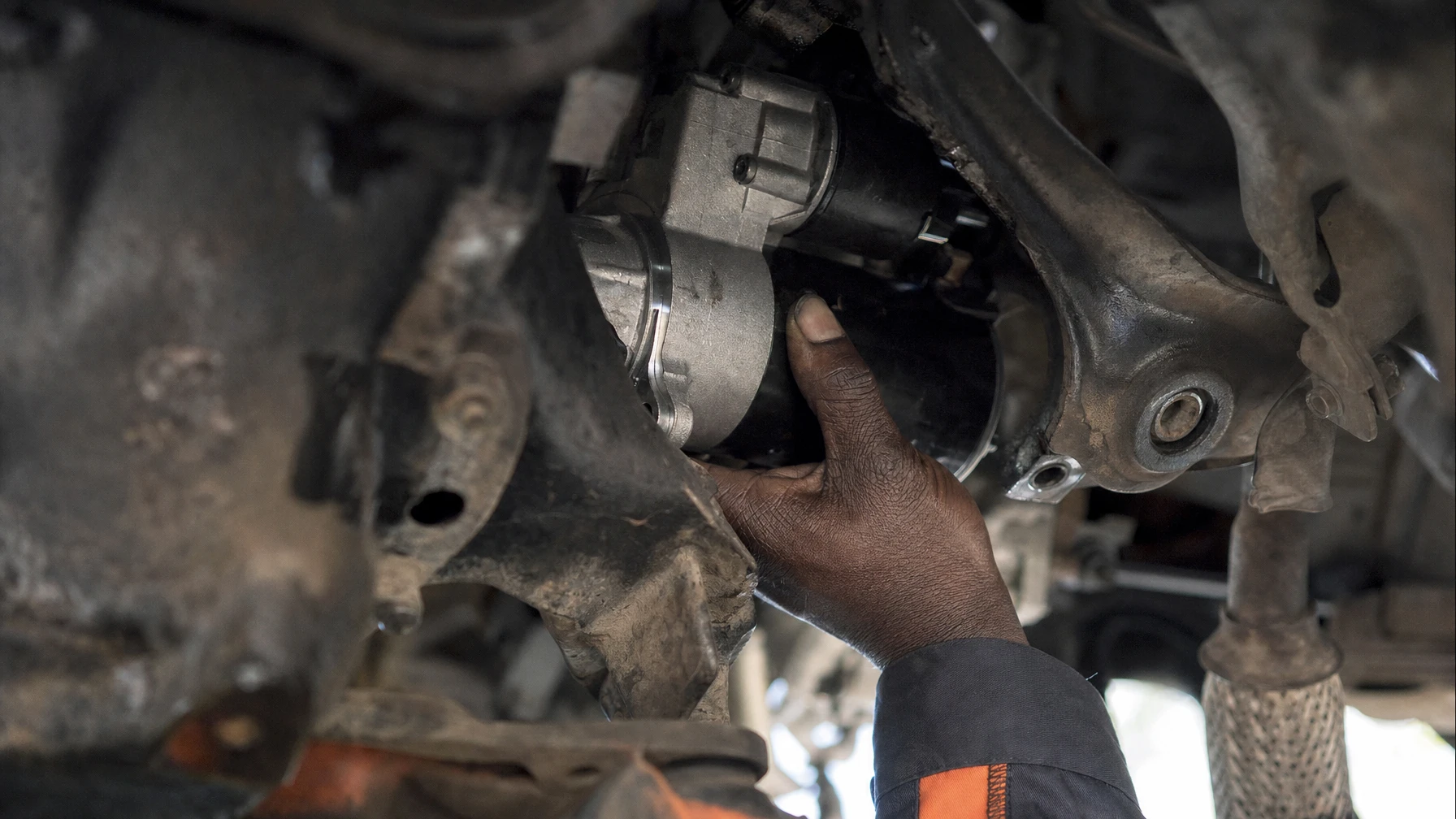
Starter replacement is priced as labor — you supply the part, or Big Tee can source it at actual cost with no markup. What swings the labor total is how hard the starter is to reach. Easy-access starters are quick. Buried ones — tucked under the intake manifold or behind other components — push the labor time (and the bill) up. Luxury and European models typically take longer to reach.
As always, the accurate number comes after a diagnosis confirms it’s the starter. Big Tee tests first, then quotes the labor in writing, and much of this can be done as a mobile mechanic job right where the car sits.
What Affects Starter Replacement Cost
- Labor to reach it. This is the biggest variable. A starter you can get to in 30 minutes costs far less to install than one that takes two hours of disassembly.
- The part you choose. New vs. remanufactured, and OEM vs. aftermarket, affect what you pay for the part itself. Quality matters — a cheap starter that fails again means paying the labor twice.
- Your vehicle. Make, model, and engine layout affect both what the part costs to buy and how long the labor takes.
Want a real starter quote, not a guess? Call or text Big Tee at (770) 780-0730 — we confirm the diagnosis, then quote in writing.
What a Real Starter Warranty Covers
Ask this before you agree to a price, not after: does the warranty cover just the part, or the labor too? A solid warranty on a remanufactured starter covers the unit itself against failure for a meaningful stretch, often a year or more, and separately covers the labor to put a warranty replacement in if the first one fails early. A parts-only warranty sounds reassuring but leaves you paying for removal and installation a second time if the starter goes bad again, which is a real cost most people don’t think to ask about until they need it.
Repair vs. Replace a Starter
For a failed starter, replacement is almost always the move — rebuilding one rarely makes sense versus a quality new or remanufactured unit, since the labor to pull it back out and reinstall it would cost nearly as much as the part itself. The real decision is part quality (good reman vs. cheap aftermarket) and, more importantly, confirming the starter is actually the problem before you buy one.
Is It the Whole Starter, or Just the Solenoid?
A starter assembly is really two parts working together: the electric motor that spins the engine, and the solenoid, a smaller electromagnetic switch bolted to it that engages the starter drive gear and completes the high-current circuit when you turn the key. On some vehicles the solenoid can be replaced on its own for less than the full assembly, on others it’s only sold as part of the whole unit, and which applies depends entirely on the vehicle. It’s a genuine question worth asking when you get a quote, since “starter replacement” doesn’t always mean the same scope of part on every car.
Make Sure It’s the Starter, Not the Battery
This is where people overspend: replacing a starter when the battery was the issue (or vice versa). The quick tells — one loud click with bright lights points to the starter; rapid clicking with dim lights points to the battery; a jump that doesn’t help leans starter.
A proper test of the starter, battery, and connections takes minutes and saves you from buying the wrong part. Most starter work can be handled in Decatur and Metro Atlanta — diagnosed and replaced where your car sits, no tow, no dealer markup.
New vs. Remanufactured Starters
The same choice that applies to alternators applies here, and since you’re the one buying the part, it’s worth understanding. A new starter costs the most and carries the tightest quality control. A remanufactured starter, a used core rebuilt with new brushes, bushings, and often a new solenoid, typically costs noticeably less while still carrying a real warranty, and it’s a solid middle ground for a routine replacement. A cheap aftermarket starter can look like the better deal on paper, but a unit that fails again in a year means paying for the labor twice, which erases whatever it saved up front.
Why Labor Varies So Much by Vehicle
Unlike a lot of parts, a starter is often mounted low, between the engine and transmission, which means the labor to reach it depends heavily on what’s in the way. On some vehicles it’s accessible from underneath with a couple of bolts. On others, it’s tucked behind the intake manifold or requires disconnecting exhaust components just to get a socket on it. That’s the real reason two shops can quote the same brand of starter at noticeably different totals: the part is the same, the number of hours to get to it isn’t.
Written by the Big Tee Auto Repair team — 29 years of mobile and shop mechanic experience in Decatur, GA and Metro Atlanta.