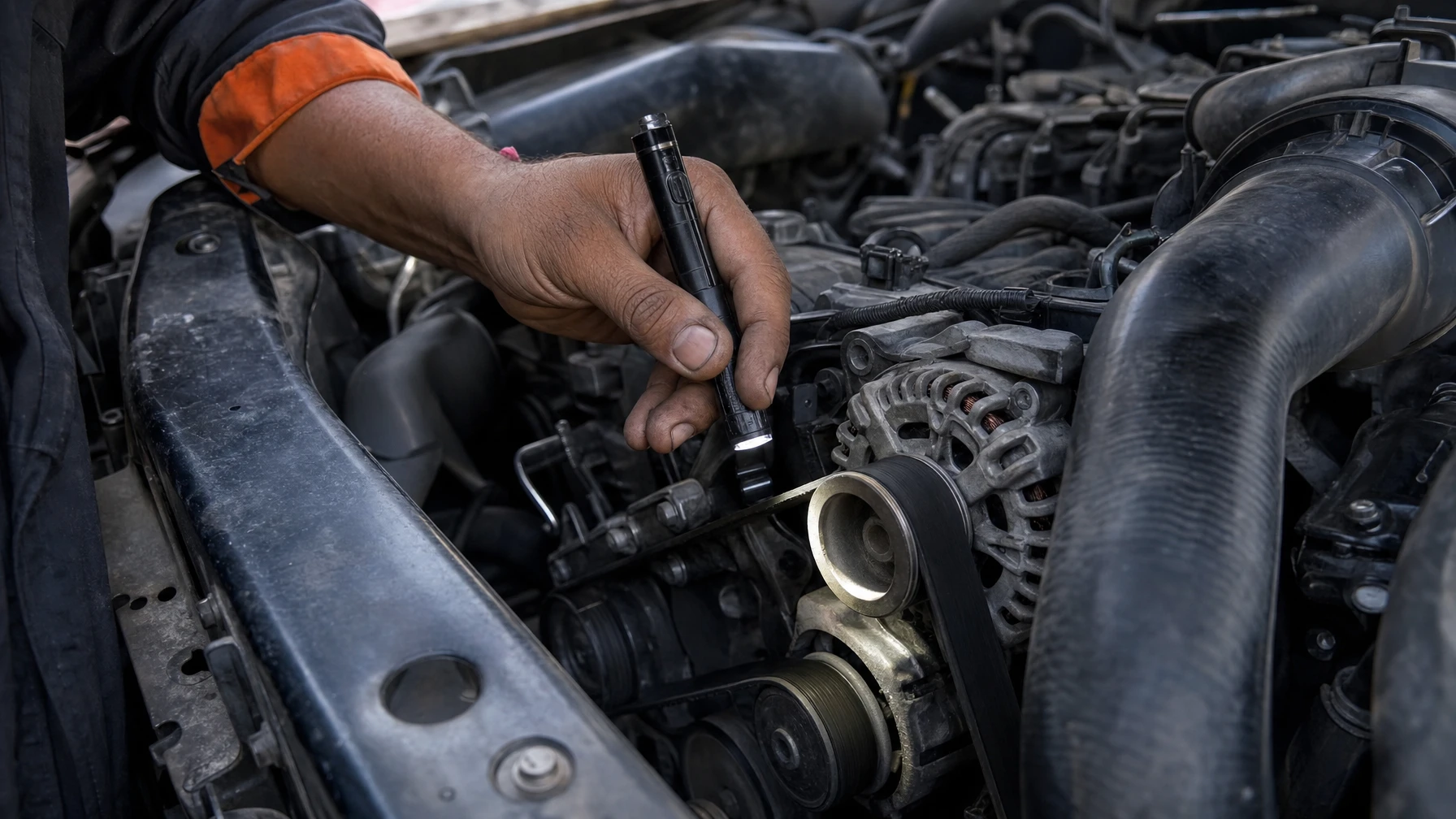
The alternator is the unsung hero of your car’s electrical system — it recharges the battery and powers everything while you drive. When it starts to fail, it rarely dies all at once; it warns you first. Here are the 7 most common bad alternator symptoms, so you can catch it before you’re stranded.
What the Alternator Does (Quick Version)
Your battery starts the car. After that, the alternator takes over — recharging the battery and running your lights, electronics, AC, and ignition. So when the alternator fails, the battery slowly drains with nothing replenishing it, and one by one things start acting up. A charging-system check like this is exactly what a mobile mechanic tests first.
7 Signs of a Bad Alternator
1. Dimming or Flickering Headlights
The classic symptom. If your headlights dim at idle and brighten when you rev, or flicker randomly, the alternator may not be keeping up with demand.
2. The Battery Warning Light
That little battery symbol on your dash covers more than the battery itself — it often signals a charging-system (alternator) problem. Don’t assume it’s “just the battery.”
3. A Battery That Keeps Dying
If you replaced the battery recently and it keeps going dead, the alternator is a prime suspect. A good battery dying repeatedly almost always means it’s not being recharged.
4. Slow or Glitchy Electrical Accessories
Power windows that crawl, a flickering dash, a radio that cuts out, dim interior lights — when voltage drops, the electrical accessories are often the first to show it.
5. Trouble Starting or Stalling
A weak alternator leaves the battery undercharged, so the car cranks slowly or struggles to start. In bad cases, the engine can stall while driving as the electrical system loses power.
Battery keep dying or lights acting up? Call or text Big Tee at (770) 780-0730 — we'll test the charging system and tell you straight: battery or alternator.
6. A Whining or Grinding Noise
A failing alternator bearing can make a whining or grinding sound. It’s easy to miss under other engine noise, but it’s a real clue.
7. A Burning Rubber or Hot Electrical Smell
An overworked alternator or a slipping/worn belt can produce a burning rubber smell, and an overheating alternator can give off a hot-wire, electrical odor. Either is worth checking promptly.
Could It Be the Belt, Not the Alternator?
Sometimes, yes, and it’s worth ruling out before paying for a new alternator. The serpentine belt is what actually spins the alternator, and a worn, glazed, or slipping belt can’t turn it fast enough to charge properly, even though the alternator itself is fine. A slipping belt often announces itself with a high-pitched squeal on startup or under load, which is a different sound from the whining or grinding of a failing alternator bearing. A belt is also a far cheaper fix, which is exactly why a proper charging-system check looks at the belt too, before anyone recommends replacing the alternator itself.
Is It the Alternator or the Battery?
This is the question, and it’s very testable. The quickest tell: jump-start the car. If it starts but dies again soon after, the alternator isn’t charging — that’s the alternator. If it starts, runs fine, and holds a charge, you’re probably looking at the battery. A proper charging-system test (battery, alternator output, and the belt) settles it in minutes.
Can a Bad Alternator Damage Anything Else?
Yes, and it’s worth knowing before you put off getting it checked. A failing alternator often puts out uneven, spiking voltage instead of a clean, steady charge as it degrades, and that electrical noise can be hard on sensitive modules and electronics that expect stable power. Running the car on a deeply discharged battery, which is what happens once the alternator stops keeping up, can also shorten that battery’s life permanently even if it tests fine today. Catching alternator trouble at the symptom stage, rather than waiting for a full stall on the road, is what keeps this a charging-system repair instead of a battery replacement and an electrical diagnosis on top of it.
Why Symptoms Get Worse the More You Run
An alternator doesn’t fail like a light switch flipping off, it fades, which is why the symptoms above often start small and build. Early on, a slightly undercharging alternator might only show up as headlights that dim a touch at idle. As output drops further, more accessories start competing for a shrinking supply, and that’s when the flickering dash, the sluggish power windows, and the eventual stall all start showing up together. Running the car longer on a failing alternator doesn’t fix anything, it just deepens the battery’s discharge and adds more hours of stress to a part that’s already struggling, which is why these symptoms are worth acting on at the dim-headlights stage rather than the stalling-on-the-highway stage.
What Does It Cost to Fix?
Alternator pricing varies by vehicle — see our breakdown of alternator replacement cost for real ranges. Either way, Big Tee handles it the same way: test first to confirm it’s actually the alternator, then a written quote before any work. Most of this can be done mobile in Decatur and Metro Atlanta — no tow needed in most cases.
Written by the Big Tee Auto Repair team — 29 years of mobile and shop mechanic experience in Decatur, GA and Metro Atlanta.