A dead battery is one of the most common reasons a car won’t start — and one of the cheaper fixes, as long as it really is the battery. Here’s what a car battery replacement costs, how long a battery should last, and the signs yours is on its way out.
Car Battery Replacement Cost
Big Tee’s labor for a battery replacement runs $65–$150, confirmed in writing after testing. On top of that is the battery itself, which you supply, or Big Tee can source at actual cost with no markup — and that’s genuinely the bulk of the total, since installation is quick on most vehicles. What the battery itself typically runs:
| Battery type | Typical retail cost | Common on |
|---|---|---|
| Standard flooded | $150–$250 | Most older/standard vehicles |
| AGM | $250–$400 | Newer cars, start-stop systems |
| Premium / large | $300–$450+ | Trucks, luxury, high-demand electrical |
The battery itself is most of the total — Big Tee’s labor is quick on the majority of vehicles and doesn’t change much by battery type. The two things that move your total are the battery type your car requires (AGM costs more than standard, and many newer vehicles require it) and the size/capacity your vehicle needs. A bigger engine or a truck with heavy electrical demand takes a larger, pricier battery, and getting the wrong one tested and swapped is exactly what a mobile mechanic visit is for.
Why AGM Batteries Cost More Than Standard Ones
The price gap isn’t padding. An AGM (absorbed glass mat) battery holds its electrolyte in fiberglass mats instead of loose liquid, which lets it handle the frequent, rapid charge-discharge cycles of engine start-stop systems, regenerative braking, and heavy onboard electronics without wearing out early. A standard flooded battery run in that same duty cycle degrades faster, which is exactly why start-stop vehicles are designed around AGM in the first place rather than it being an upsell. Putting a standard battery in a car engineered for AGM is a real downgrade: it can leave the start-stop system disabled or shorten the battery’s life further.
Car cranking slow or not starting? Call or text Big Tee at (770) 780-0730 — we'll test the battery and charging system and replace it on the spot if that's the issue.
How Long Does a Car Battery Last?
Most car batteries last 3–5 years, but a few things shorten that — and one of them is living in Georgia:
- Heat. This is the big one. High temperatures accelerate the chemical wear inside a battery, so hot climates routinely see batteries fail at the shorter end of the range.
- Short trips. Quick drives don’t fully recharge the battery, so a pattern of short hops slowly drains its reserve over time.
- Accessories and parasitic drain. Heavy electrical loads and small drains (a light staying on, a faulty module) shorten life.
- Age. Even a healthy battery is on borrowed time past about four years.
If yours is in that 3–5 year window and acting up, replacement is the likely answer — but a test confirms it. A battery that’s still within its normal window and acting up is worth checking for a simpler cause first, since a battery isn’t guaranteed to fail exactly on schedule and a healthy one can be dragged down by a parasitic drain, a bad connection, or a charging problem that has nothing to do with its age.
Signs Your Car Battery Is Dying
- A slow, labored crank when you start the car
- The battery warning light on the dash
- Dimming headlights or interior lights, especially at idle
- Electrical glitches — flickering displays, power accessories acting up
- Needing a jump to get going (if it keeps happening, the battery’s done)
- Age — more than 3–4 years in a hot climate
- Corroded or loose terminals — the white or bluish crust that builds up on a battery post adds resistance to the connection, which can mimic a weak battery even when the battery itself is fine. A baking-soda-and-water scrub and a tight, clean connection sometimes solves a “dead battery” that was never actually dead
If you’re stuck right now, a jump start gets you moving, but a jump is a temporary fix, not a diagnosis.
How a Battery Actually Gets Tested
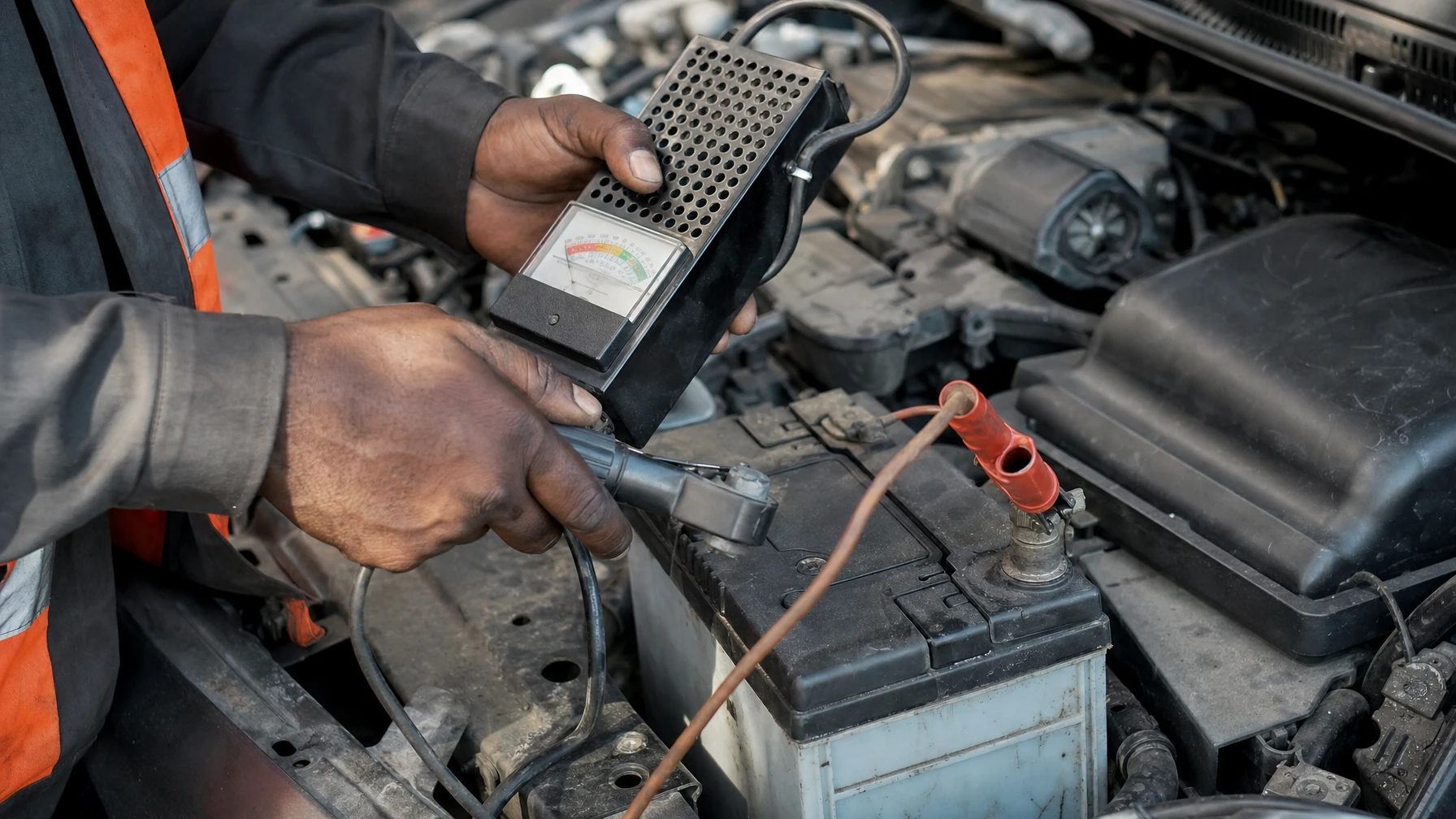
A voltmeter reading alone doesn’t tell the whole story. A battery can show a normal resting voltage and still fail under real load, which is why a proper test uses a load tester: it draws current from the battery the way the starter would and watches how the voltage holds up under that draw, rather than only while it’s sitting idle. That’s the difference between “it reads fine” and “it actually works,” and it’s also how a test tells a weak battery apart from a healthy one that’s simply not being charged, which points at the alternator instead.
Battery or Alternator? Don’t Guess
Here’s the catch that trips a lot of people up: a dying battery and a failing alternator cause nearly identical symptoms — slow cranks, dim lights, needing jumps. Replace the battery when the real problem is the alternator, and you’ll be stranded again in days. That’s why a proper test checks both the battery and the charging system. If the alternator turns out to be the culprit, our guide on bad alternator symptoms covers that side of it.
The Honest Approach
Big Tee tests before replacing — confirming it’s the battery (and the charging system is healthy) so you don’t pay for the wrong part. Battery replacement is a natural mobile mechanic job, done right in your driveway across Decatur and Metro Atlanta with the correct battery type for your vehicle and the price agreed up front.
Test first, replace once, and get back on the road. That’s the whole job.
Written by the Big Tee Auto Repair team — 29 years of mobile and shop mechanic experience in Decatur, GA and Metro Atlanta.