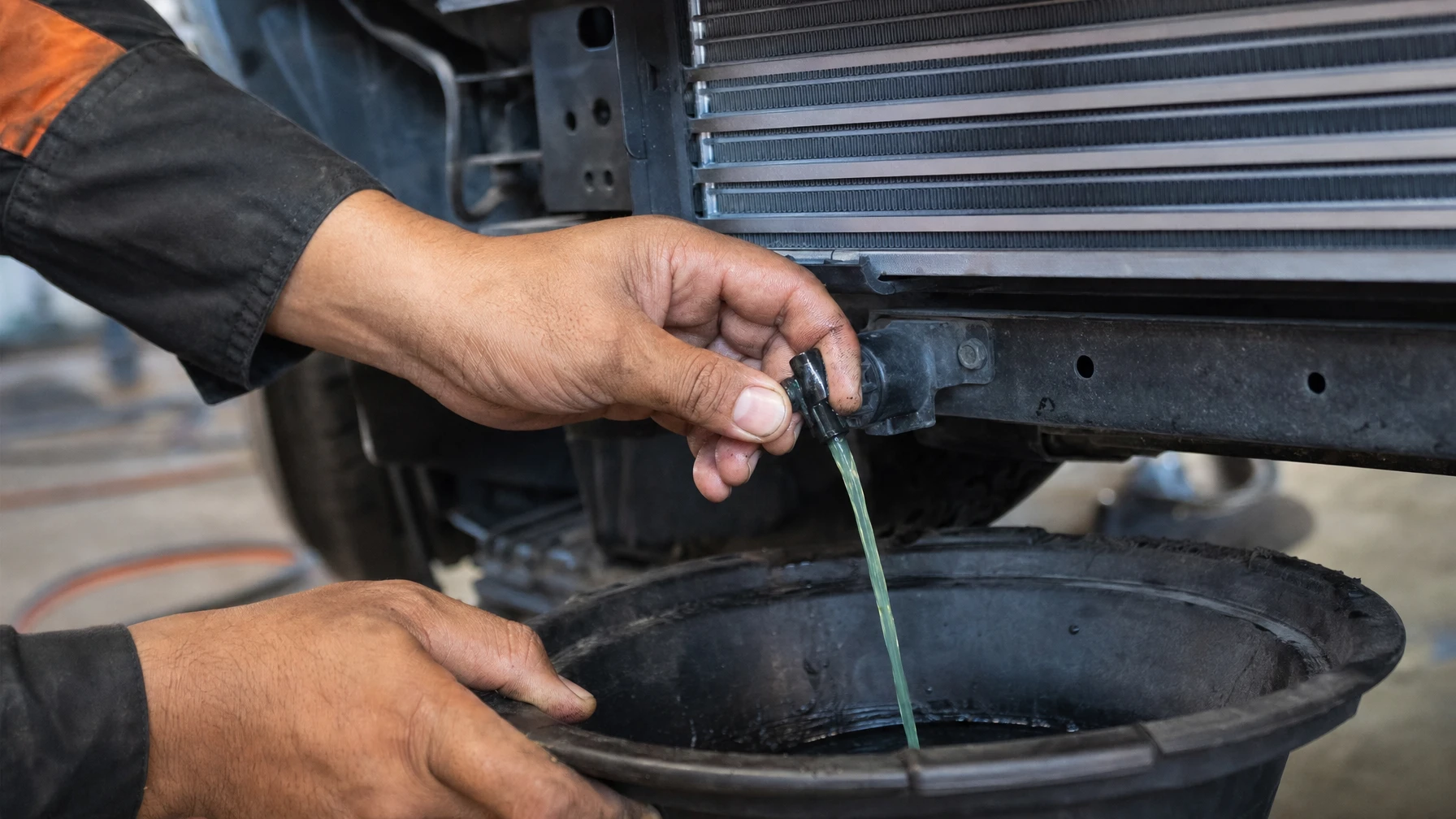
A coolant flush is one of the cheapest services on your car and one of the easiest to skip — which is exactly why neglected coolant is behind so many radiator and water pump failures. The flush costs a little; the failures it prevents cost a lot.
Here’s what a coolant flush costs, how often you actually need one, and the signs yours is overdue.
Coolant Flush Cost
Most coolant flushes run $100–$200. What moves the price:
| Service | Typical cost | What you get |
|---|---|---|
| Drain & fill | $80–$150 | Replaces part of the coolant |
| Full machine flush | $130–$200 | Exchanges nearly all coolant + cleans system |
| Long-life / import coolant | $150–$250+ | Vehicles needing specific coolant |
The two factors are which coolant your vehicle takes (long-life and import-specific coolants cost more per gallon) and flush vs. drain-and-fill. Either way, it’s a modest service — and a fraction of what a coolant leak or overheating repair runs once a corroded system starts failing. These figures are typical market totals; Big Tee prices the work as labor, with coolant billed separately at actual cost, confirmed in writing before anything is drained.
Not sure when your coolant was last done? Call or text Big Tee at (770) 780-0730 — we'll check its condition and tell you straight whether it needs a flush.
See Big Tee’s engine repair page for Decatur for the full range of what’s covered, cooling system included.
How Often Should You Flush Coolant?
A reasonable rule is every 30,000–60,000 miles or every 3–5 years, but it genuinely depends on your vehicle and the type of coolant. Some modern long-life (OAT) coolants are rated to 100,000 miles or more. A few pointers:
- Check your owner’s manual for the specific interval and coolant type.
- Heat shortens the life — Georgia summers and stop-and-go traffic are hard on coolant.
- If you can’t remember the last one, it’s due — same simple test as any fluid.
What’s the Difference Between a Coolant Flush and a Drain-and-Fill?
- Drain-and-fill — opens the radiator, drains what comes out, and refills. It replaces a portion of the coolant. Cheaper, and fine as routine upkeep.
- Flush — uses a machine or a flushing agent to push out nearly all the old coolant plus the rust and scale it’s collected, then refills with fresh coolant. More thorough, and the better choice when the coolant is old, dirty, or the system has never been serviced.
A good mechanic recommends the one your car actually needs — not automatically the pricier flush.
Signs You Need a Coolant Flush
- Rusty, brown, or murky coolant instead of clean green/orange/pink
- Coolant that’s low or needs frequent topping off (also check for a leak)
- The engine running hotter than normal or creeping up in traffic
- A sweet smell or visible scale around the cap and reservoir
- It’s simply been too long — past the mileage or years in your manual
Why It Matters
Fresh coolant does two jobs: it transfers heat to keep the engine cool, and its additives protect against corrosion inside the radiator, water pump, and engine. As coolant ages it turns acidic and loses both abilities — quietly eating the cooling system from the inside until a part fails. That’s why skipped flushes show up later as a dead water pump, a corroded radiator, or an overheating engine.
Big Tee can flush your coolant right in your driveway as a mobile mechanic in Decatur serving Metro Atlanta, using the correct coolant for your vehicle and checking the system for leaks while we’re at it. Cheap service, big payoff — keep the cooling system healthy and it keeps your engine alive.
Written by the Big Tee Auto Repair team — 29 years of mobile and shop mechanic experience in Decatur, GA and Metro Atlanta.