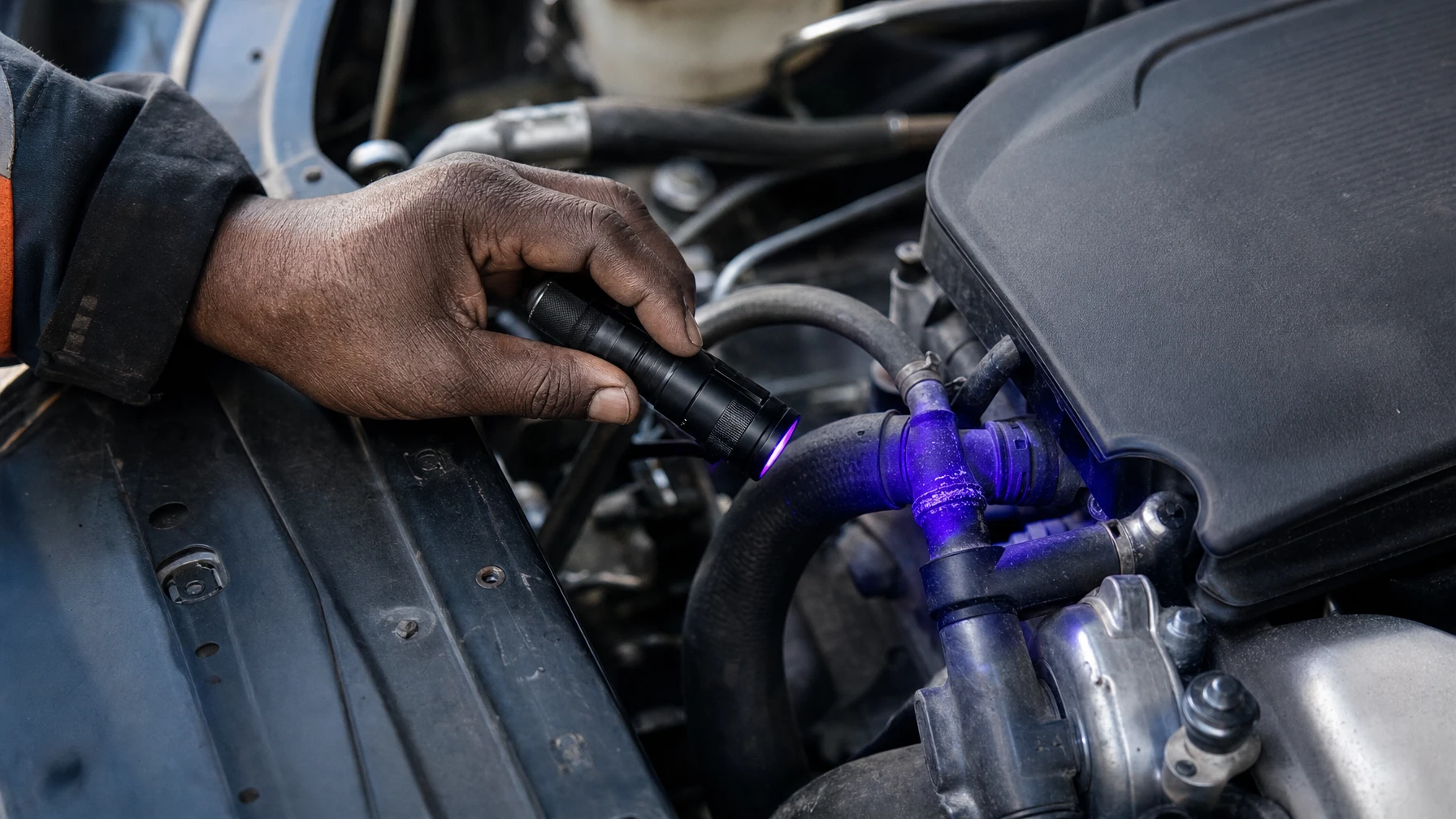
A coolant leak is one of those repairs where the price swings enormously based on one thing: where it’s leaking. The same green or orange puddle under your car could be a $40 hose clamp or a $2,000 head gasket — and in a Georgia summer, it’s not a repair you want to put off, because coolant is the only thing keeping your engine from cooking itself.
Here’s the real cost of coolant leak repair by source, why it’s happening, and what to do about it.
Coolant Leak Repair Cost by Source
| Leak source | Typical repair cost | Why |
|---|---|---|
| Hose or clamp | $20–$200 | Cheap parts, quick labor |
| Radiator cap | $15–$50 | Often the simplest fix |
| Coolant reservoir | $100–$350 | Cracked plastic overflow tank |
| Thermostat housing | $150–$400 | Common leak point |
| Radiator | $300–$900 | Replacement + refill |
| Water pump | $400–$900 | Labor-heavy; see below |
| Head gasket (internal) | $1,000–$2,500+ | Major labor |
The pattern is the same as most repairs: the part is rarely the expensive part — the labor to reach it is. A split hose is cheap and fast. A head gasket costs far more mainly because it’s buried deep in the engine, and those extra hours of labor are what drive the bigger number — exactly why a proper diagnosis matters before anyone quotes you.
These are typical repair totals across the market. Big Tee prices the work as labor, with the failed part sourced separately at actual cost, and gives you the real number in writing after a pressure test confirms the source — never a guess based on the puddle color alone.
If the source turns out to be the pump, our water pump replacement cost breakdown covers that job specifically.
Coolant on the driveway? Call or text Big Tee at (770) 780-0730 — we'll pressure-test it and find the real source before you pay to fix the wrong thing.
See Big Tee’s engine repair services in Decatur for the full picture, from a small leak to a full rebuild.
Why Is My Car Leaking Coolant?
Coolant lives in a sealed, pressurized loop, so a leak means something in that loop has failed. The usual suspects:
- Hoses and clamps — rubber hardens and cracks with heat and age; clamps loosen
- The radiator — corrosion or impact damage opens a seam or the core
- The water pump — its shaft seal weeps coolant as it wears
- The thermostat housing — a common gasket leak
- The coolant reservoir — the plastic overflow tank cracks over time
- The radiator cap — a worn cap can’t hold pressure and lets coolant escape
- The head gasket — the serious one; an internal leak that can mix coolant and oil
The color of the puddle helps: coolant is usually bright green, orange, pink, or yellow and has a sweet smell — which is also why it’s dangerous to pets, so clean up spills.
Car Leaking Coolant When Parked vs. Only When Hot
A puddle when parked points to an external leak under pressure that drips once the system is full — a hose, the radiator, the pump, or the reservoir.
Coolant that only disappears when the engine’s hot — with no visible puddle — can mean it’s leaking internally (a head gasket) and being burned off, often with white, sweet-smelling exhaust smoke. That’s the more serious scenario and worth checking quickly, since it can escalate fast.
Either way, if your temperature gauge climbs or you’re topping off coolant regularly, don’t wait — our guide on why your car is overheating walks through what’s happening and why heat does so much damage.
Does Radiator Stop-Leak Work?
You’ll see bottles of stop-leak promising an easy fix. The honest take: they can temporarily seal a tiny pinhole, which might get you home in a pinch. But they don’t repair the failed part, and the same particles that plug a leak can also clog your radiator, heater core, and water pump — turning a cheap repair into an expensive one. Use it as a roadside emergency patch if you must, not as the actual fix.
Don’t Drive on a Coolant Leak
This is the part that matters most: coolant is what stops your engine from overheating, and an overheated engine is one of the most expensive failures there is — warped cylinder heads, a blown head gasket, sometimes a ruined engine. A coolant leak caught early is often a cheap hose or clamp. The same leak ignored until the temp gauge spikes can cost thousands.
Big Tee finds coolant leaks the right way — a pressure test to pinpoint the exact source — often right in your driveway as a mobile mechanic in Decatur serving Metro Atlanta, with a written price before any work. Catch it early, fix the right part, and keep your engine cool through the summer.
Written by the Big Tee Auto Repair team — 29 years of mobile and shop mechanic experience in Decatur, GA and Metro Atlanta.
Related guide: How Much Does a Coolant Flush Cost?.