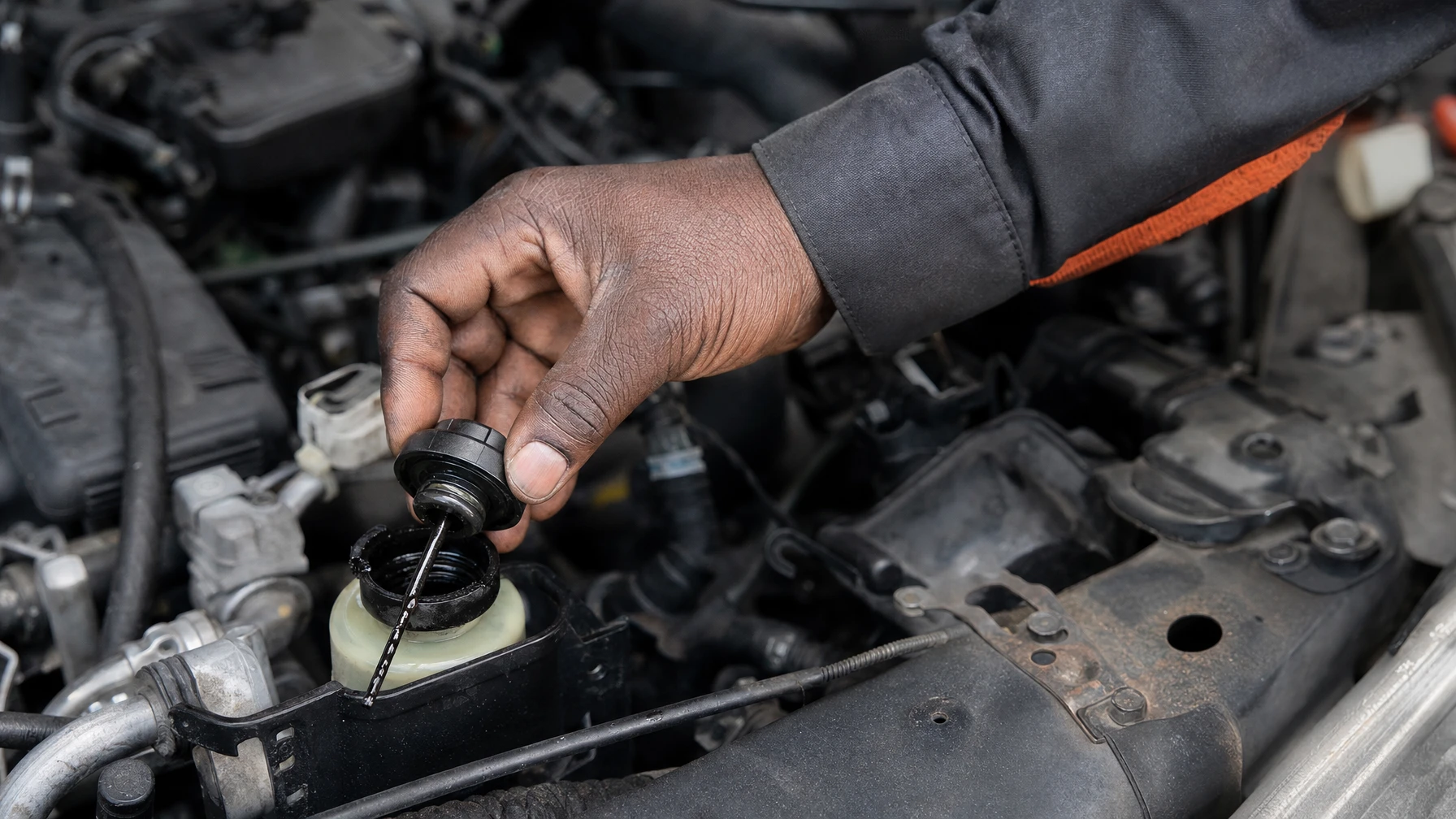
Power steering fluid is easy to forget about. Then the wheel goes stiff and starts whining. Checking it takes a couple of minutes and can catch a problem before it leaves you fighting the steering. Here’s how to check power steering fluid the right way, what the color tells you, and which fluid to use.
How to Check Power Steering Fluid Level
- Find the reservoir. Pop the hood and look for the power steering reservoir — it’s usually a small tank labeled with a steering-wheel icon or “power steering,” with MIN/MAX marks on the side or a dipstick in the cap.
- Check it at the right temperature. Many reservoirs have separate “COLD” and “HOT” ranges. For a cold reading, check with the engine off and cool; for a hot reading, after the car’s been running. Read against the matching marks.
- Read the level. If the cap has a small dipstick, wipe it, reinsert, and pull it to read. Otherwise read the fluid against the side marks.
- Top up only if low — and only with the correct fluid for your vehicle (more on that below). Don’t overfill.
Power steering fluid is only one part of what keeps the front end quiet and predictable. If you’re also hearing noise or feeling looseness that has nothing to do with fluid, that’s a different problem: it crosses into full suspension and steering repair territory, beyond a simple top-off.
What Color Should Power Steering Fluid Be?
The color is a quick health check:
- Clear, amber, pink, or red — healthy (the exact color depends on the fluid type)
- Brown — aging; getting due for a service
- Dark, burnt-smelling, or foamy — degraded or full of air; have it looked at
- Black flecks in it — can signal internal wear in the pump or rack
Foamy or bubbly fluid often means air is getting in — which, with a low level, points to a leak drawing air into the system.
Fluid low, dark, or foamy? Call or text Big Tee at (770) 780-0730 — we'll check the system and tell you straight whether it's a top-off or a leak.
What Kind of Power Steering Fluid Should You Use?
This matters more than people realize: use the fluid your vehicle specifies. Check the owner’s manual or the cap. Some vehicles take a dedicated power steering fluid; others are designed for a specific automatic transmission fluid (ATF). The wrong fluid can swell or damage the seals and pump, so confirm before you pour. If you’re unsure, that’s a good reason to have it checked rather than guess.
What Low Power Steering Fluid Is Telling You
Here’s the key point: the power steering system is sealed, so it doesn’t use up fluid. If the level is low, it’s leaking somewhere: a hose, the pump, the rack, or a seal. Topping it off restores the steering for a while, but the fluid keeps escaping and the whine and hard steering come back. That’s why low fluid is best treated as a find-the-leak signal, and it’s worth ruling out the sources and repair cost before you drive on it much longer.
The Honest Approach
Big Tee can check your power steering fluid, confirm the correct type, and trace any leak, often right in your driveway across Decatur and Metro Atlanta. If it’s just low and there’s no leak, that’s an easy top-off. If it’s leaking, you’ll get a straight diagnosis and a written price first.
While you’re paying attention to the front end, it’s worth knowing the signs of a worn wheel bearing too — a different part with a different symptom (a growing hum rather than a fluid leak), but one that tends to show up around the same age and mileage.
Two minutes with the reservoir can save you a stiff, whining drive — and catch a leak before it costs a pump.
Written by the Big Tee Auto Repair team — 29 years of mobile and shop mechanic experience in Decatur, GA and Metro Atlanta.