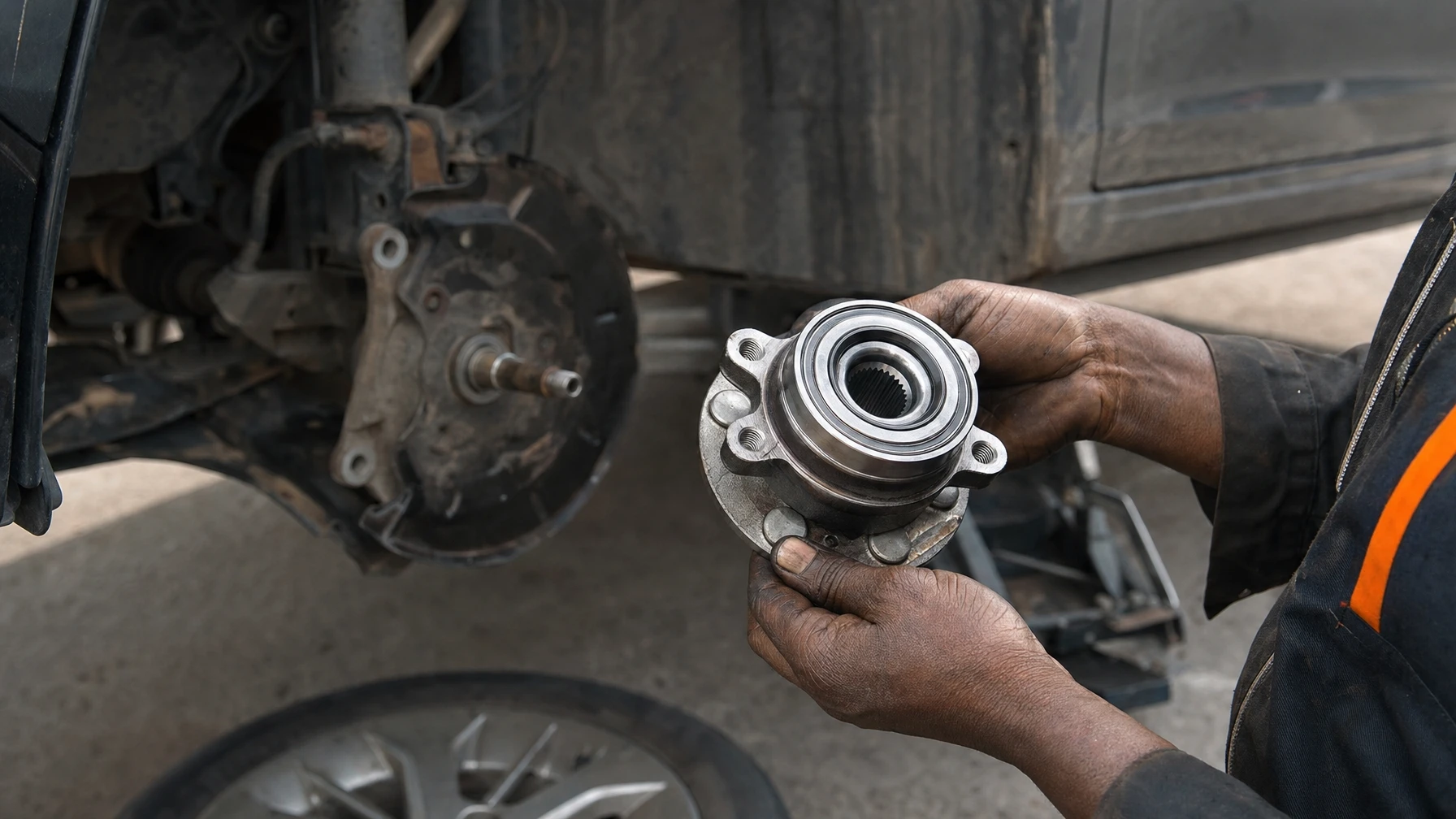
That humming, growling noise that gets louder the faster you go? That’s the most common sign of a failing wheel bearing — and it’s one of those repairs where safety is the real issue, not comfort. Here’s what wheel bearing replacement costs, how to spot a bad one, and why you don’t want to ride it out.
Wheel Bearing Replacement Cost
Wheel bearing work is priced as labor, the same as the rest of Big Tee’s suspension repair — you supply the part, or Big Tee can source it at actual cost with no markup, and the labor total is confirmed in writing once the wheel and bearing are inspected. What moves the labor time:
| Factor | Effect on labor |
|---|---|
| Bolt-in hub assembly | Quicker — usually the lower end |
| Pressed-in bearing | More labor, sometimes a hydraulic press |
| 4WD / AWD vehicles | Often more involved |
| Front vs. rear | Varies by vehicle layout |
The biggest factor is bearing type. Many modern cars use a bolt-in hub assembly that comes off and on relatively quickly. Older or different designs use a pressed-in bearing that takes more labor and sometimes a hydraulic press — which is why the labor time, and the bill, can differ a lot between two cars with the exact same symptom. It’s priced per wheel, and bearings usually fail one at a time.
Hearing a growl that gets louder with speed? Call or text Big Tee at (770) 780-0730 — we'll pinpoint which wheel and quote it straight.
Symptoms of a Bad Wheel Bearing
The Humming or Growling Noise
The signature symptom. A humming, growling, or roaring sound that grows with speed — and a key tell: it often changes when you turn or change lanes. If the noise gets louder turning left and quieter turning right (or vice versa), that points to the bearing on a specific side, because weight shifts onto it in the turn.
A Loose or Wobbly Wheel
A badly worn bearing lets the wheel develop play — a slight wobble. This is the more dangerous stage, because it affects how the wheel is held to the car.
Vibration and Uneven Tire Wear
A wobbling wheel transmits vibration through the steering and causes uneven tire wear — and if you’ve noticed a shimmy at speed, a bad bearing is one of several possible causes worth ruling out alongside tire balance and other suspension wear.
An ABS or Traction-Control Light
Many wheel bearings house the ABS speed sensor, so a failing bearing can throw an ABS or traction-control warning light along with the noise.
Why You Shouldn’t Drive on a Bad Wheel Bearing
This is the part that matters: a wheel bearing holds your wheel to the car and lets it spin smoothly. When it fails badly enough, it can seize — or let the wheel develop enough play to come loose — and either one at highway speed is genuinely dangerous. A bearing also never heals; the noise only grows until the part is replaced. Catch it early and it’s a routine per-wheel job; ignore it and you’re risking control of the car.
The Honest Approach
Big Tee confirms it’s actually the bearing — and which wheel — before quoting, since a growl can sometimes be tires, a ball joint, or another front-end part. A lot of bearing work happens right in your driveway across Decatur and Metro Atlanta, with the bigger pressed-in jobs handled at the shop — diagnosed first, quoted in writing, no guessing.
Don’t ride out a growling wheel. It’s a safety part, and it only gets worse.
Written by the Big Tee Auto Repair team — 29 years of mobile and shop mechanic experience in Decatur, GA and Metro Atlanta.