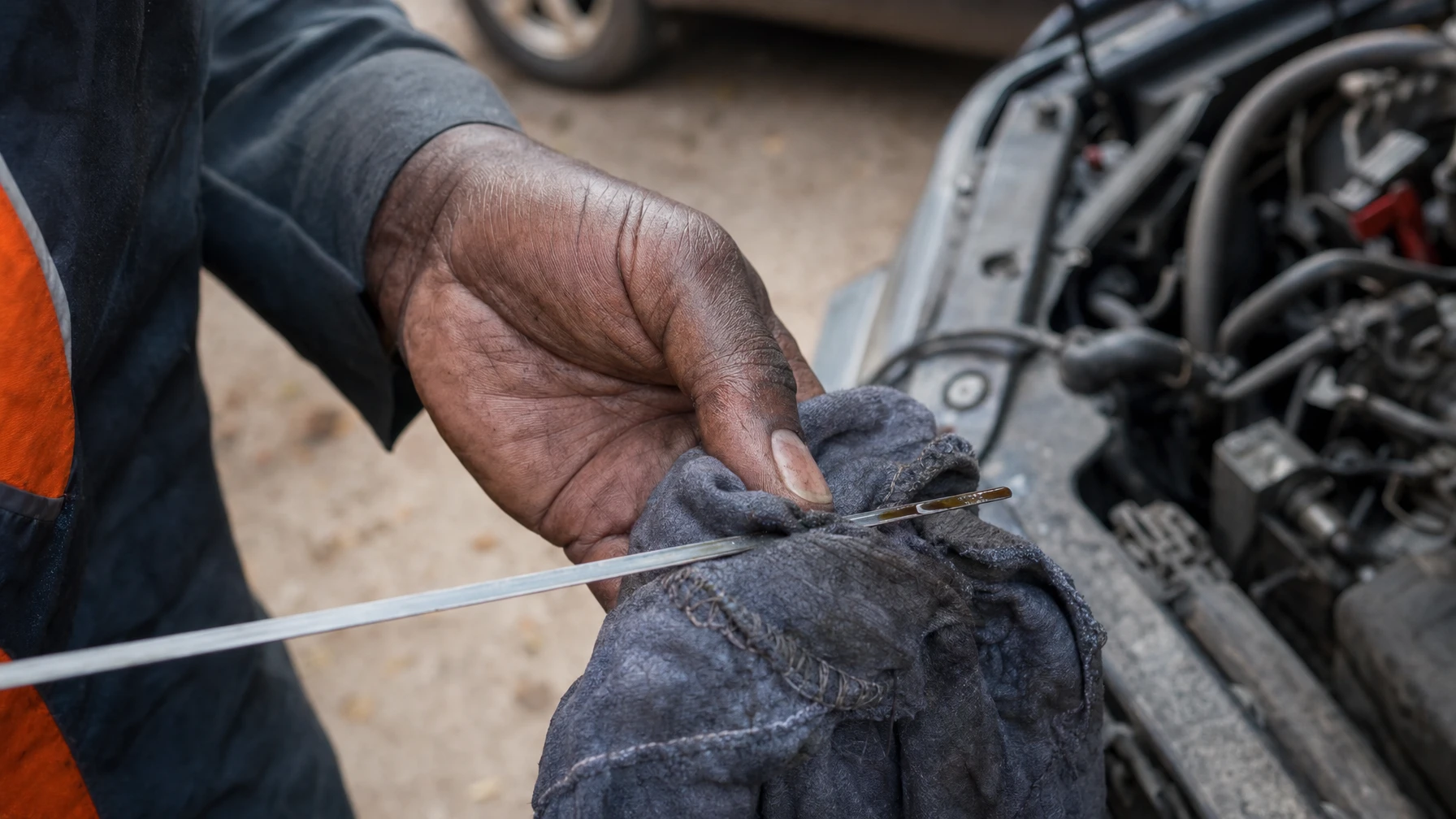
Checking your transmission fluid is one of the few under-hood checks that can save you from a multi-thousand-dollar repair, but only if you do it the right way. Done wrong (cold engine, off when it should be on, car on a slope), you’ll get a reading that’s flat-out misleading.
Here’s how to check transmission fluid properly: the level, what the color is telling you, and the signs that mean you should stop checking and start calling.
How to Check Transmission Fluid Level (With a Dipstick)
If your vehicle has a transmission dipstick (many cars built before the mid-2010s do), the check takes about five minutes:
- Park on level ground. An incline throws the reading off.
- Warm the engine up. Transmission fluid expands as it heats, and most dipsticks are calibrated to read at operating temperature.
- For most automatics, leave the engine running in park. This is the big one — most automatic transmissions are checked running, unlike engine oil. Always check your owner’s manual, because a few makes specify engine-off, and getting this backward gives a false level.
- Find the transmission dipstick. It’s usually toward the back of the engine bay and often has a colored handle. (Don’t confuse it with the engine oil dipstick up front.)
- Pull it, wipe it clean, reinsert it fully, then pull it again and read the level against the “full” marks.
- Top up only if needed, in small amounts, using the exact fluid your vehicle specifies — and don’t overfill.
A dipstick check like this is part of what a real transmission repair inspection covers before any bigger diagnosis starts.
How Much Fluid Should You Add?
Add it a little at a time, checking the level after each small pour rather than guessing the whole amount up front. Most dipsticks have a gap of well under a quart between “add” and “full,” so it takes less fluid than people expect, and overfilling causes its own problems: aerated, foamy fluid that shifts just as badly as fluid that’s too low. If you’re adding more than half a quart to get from low to full, that usually means there’s a leak to find, beyond routine topping off.
What Color Is Transmission Fluid Supposed to Be?
The dipstick tells you more than the level — the color and smell are a quick health check:
- Bright to dark red, fairly clear — healthy fluid. You’re good.
- Brown — the fluid is aging and getting due for a change.
- Dark brown or near-black, with a burnt smell — overdue, and the transmission has been running hot. Service it before it does damage.
- Milky or foamy — possible coolant contamination, which is a bigger problem worth getting looked at.
If the color says it’s time, our breakdown of transmission fluid change cost covers what the service runs and how often to do it.
Fluid look brown or smell burnt? Call or text Big Tee at (770) 780-0730 — we'll check it right and tell you straight whether it needs service.
Low Transmission Fluid Symptoms
You don’t always need a dipstick to suspect a problem; the transmission will tell you. These are the classic low-fluid warning signs:
- Slipping — the engine revs but the car is slow to actually move or accelerate.
- Delayed or hard shifts — a pause before the car engages in drive or reverse, or harsh, clunky shifts.
- Overheating or a burning smell — low fluid can’t cool the transmission properly.
- A reddish puddle under the car — a transmission fluid leak. Since the system is sealed, low fluid almost always means it’s leaking somewhere and needs actual repair, beyond a top-off.
Any of these is worth getting checked sooner rather than later — slipping in particular is the symptom most likely to turn into a rebuild if it’s ignored.
Checking a CVT’s Fluid
A CVT (continuously variable transmission) usually gets checked the same basic way as a standard automatic when it has a dipstick, but two things are different enough to matter. First, CVT fluid is its own specific formulation, not interchangeable with standard automatic transmission fluid or with another manufacturer’s CVT fluid, so the level check tells you the story but any top-up has to use the exact spec fluid. Second, many CVTs are sealed with no dipstick at all, which pushes the check to the same underneath, temperature-specific process a sealed automatic needs.
What if There’s No Transmission Dipstick?
A lot of newer vehicles use sealed transmissions with no dipstick at all. On those, you can’t do a driveway dipstick check — the fluid is checked from underneath through a fill/check plug, at a specific fluid temperature, with the car perfectly level. Both temperature and level have to be exact or the reading is wrong, which is why sealed-transmission checks are a mechanic’s job.
That’s not a reason to ignore it. It just means the check happens with the right setup instead of a dipstick — and overfilling or underfilling a sealed unit causes its own problems, so it’s worth doing properly.
When to Let a Mechanic Handle It
A dipstick level-and-color check is fair game for any owner. Beyond that (a sealed transmission, fluid that’s brown or burnt, a leak, or any slipping or hard-shifting) is where you want a mechanic, because the wrong fix, or the wrong fluid, can cost far more than the check.
Big Tee can check your transmission fluid right in your driveway across Decatur and Metro Atlanta, sealed transmissions included. If it turns out the fluid’s overdue or there’s a leak, you get a straight recommendation and a written price first, whether that’s a full fluid change or something bigger.
Five minutes with a dipstick — or one quick check from a mechanic on a sealed unit — is cheap insurance against the most expensive part of your car.
Written by the Big Tee Auto Repair team — 29 years of mobile and shop mechanic experience in Decatur, GA and Metro Atlanta.