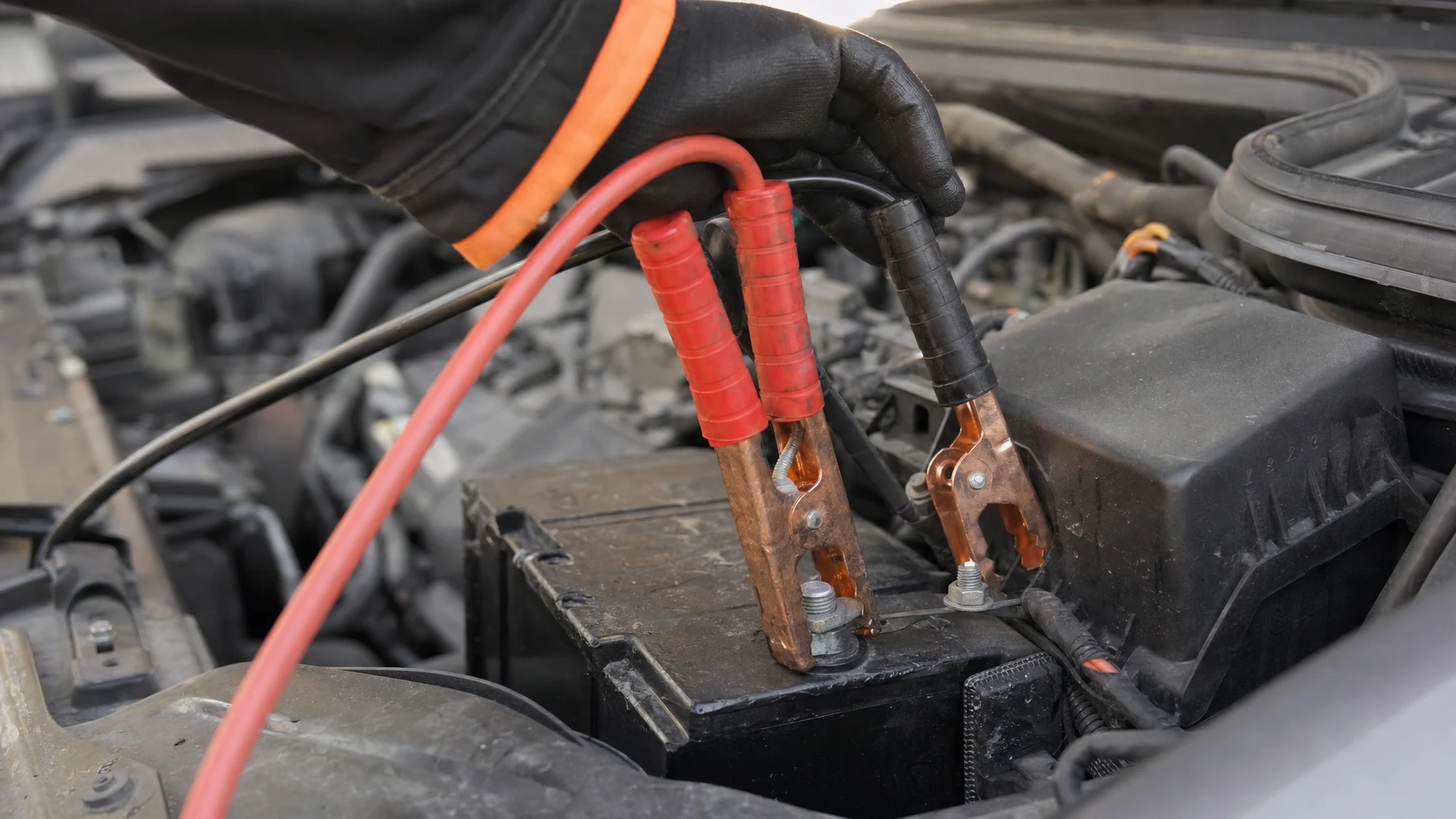
A dead battery always seems to happen at the worst time. The good news: jump starting a car is simple and safe — as long as you connect the cables in the right order. Here’s the step-by-step, the mistakes to avoid, and the part most people miss: when a jump is quietly telling you something bigger is wrong.
What You Need
- A set of jumper cables (or a portable jump pack, which skips needing a second car)
- A running vehicle with a healthy battery (for cable jumps)
- Both cars in park/neutral, engines off, keys out
If jumping it feels like more than you want to take on, that’s exactly what a mobile mechanic is for.
How to Jump Start a Car: Step by Step
Connect the clamps in this exact order — it matters for safety:
- Red (+) to the dead battery’s positive terminal. It’s marked with a +.
- Red (+) to the good battery’s positive terminal.
- Black (–) to the good battery’s negative terminal.
- Black (–) to bare metal on the dead car’s engine — an unpainted bolt or bracket, away from the battery. Do not clamp it to the dead battery’s negative post.
Then:
- Start the working car and let it run a couple of minutes.
- Start the dead car. If it cranks and starts, good.
- Disconnect in reverse order — black from engine metal, black from good battery, red from good battery, red from the revived battery.
- Keep the revived car running — drive or idle 20–30 minutes (a real drive is best) so the alternator can recharge the battery.
Stuck with a no-start in Decatur or Metro Atlanta? Call or text Big Tee at (770) 780-0730 — we'll come to you, get you running, and find out why it died.
Why the Cable Order Matters
That last connection — black clamp to engine metal instead of the battery — isn’t fussiness. A weak battery can give off a small amount of hydrogen gas, and the final connection is where a tiny spark can happen. Grounding it to bare metal away from the battery keeps that spark away from the gas. It’s a five-second habit that prevents the rare but real risk of a battery spark.
A few other safety notes:
- Match the clamps correctly — red to positive, black to negative. Reversing them can damage both cars’ electronics.
- Don’t let the clamps touch each other while connected.
- If the battery is cracked, leaking, or frozen, don’t jump it — call for help.
Jump Pack or Jumper Cables?
A portable lithium jump pack does the same job as cables and a second car, and it’s worth having if you drive somewhere isolated or live alone: no flagging down a stranger, no coordinating two cars in traffic, just clamps to your own battery and a button. The tradeoff is that a jump pack needs its own charge, so a pack that’s been sitting dead in your trunk for a year won’t help you either, and it’s worth topping it off every few months rather than assuming it’s ready the one time you actually need it. Cables need a second running vehicle, but they never run out of their own battery. Either works the same way once connected, following the same red-then-black order described above; the honest answer is a charged jump pack is the more reliable option precisely because it doesn’t depend on finding someone else’s car, a running engine, and a safe spot to park it next to yours.
When a Jump Means a Bigger Problem
This is the part that matters most. A jump start gets you moving, but it’s a temporary fix, not a diagnosis. Pay attention to what happens next:
- It started and stays fine for weeks — probably a one-time drain (a light left on). No big deal.
- It dies again, or needs repeated jumps — the battery isn’t holding a charge (likely worn out), or the alternator isn’t recharging it.
- It won’t even take a jump, or the battery light stays on while driving — that points to the charging system, beyond the battery alone.
If your car keeps dying, the cause is usually a worn-out battery, a failing alternator, or a starter/electrical issue, and they’re worth telling apart rather than guessing. Our battery replacement cost breakdown covers the first of those, including how long a battery should last in the first place.
Can You Damage a Car by Jump Starting It Wrong?
Yes, though it takes real carelessness to do it. Reversing the clamps (red to negative, black to positive) can send current the wrong way through sensitive electronics and blow fuses or damage modules on either car, sometimes expensive ones, which is exactly why the connection order matters as much as it does. Letting the clamps touch each other while connected can throw sparks near battery gas. On modern cars packed with computers, a botched jump is a real way to turn a dead battery into a much bigger bill, which is the whole reason the order and the grounding step aren’t optional steps to skip when you’re in a hurry.
The Honest Approach
A jump is step one. The real answer is why it died. Big Tee can come to you across Decatur and Metro Atlanta, test the battery and the charging system to find the actual cause, and replace the battery right there if that’s it — so you’re not jump-starting your car every morning waiting for it to leave you stranded.
Get the jump, then get the answer.
Written by the Big Tee Auto Repair team — 29 years of mobile and shop mechanic experience in Decatur, GA and Metro Atlanta.