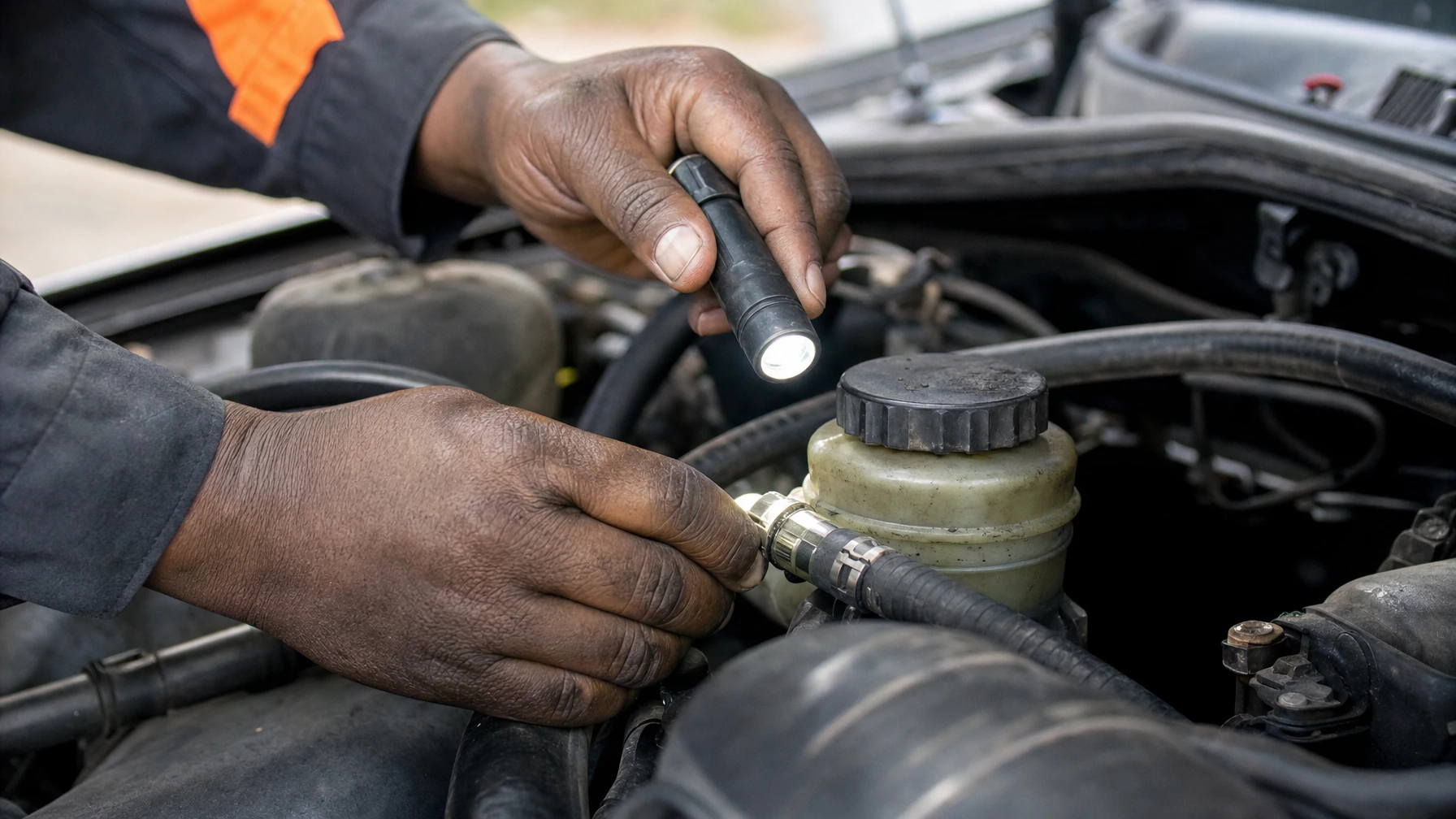
Hard steering paired with a whine every time you turn the wheel is one of the most recognizable car problems there is — and it almost always traces back to a power steering fluid leak. Here’s how to spot it, where the fluid escapes from, what the repair costs, and why you shouldn’t just keep topping it off.
Signs of a Power Steering Fluid Leak
- A whining or groaning noise when you turn — the signature symptom, worst at low speed and full lock
- Heavy, stiff steering — the wheel takes more effort, especially parking or pulling out slowly
- A low power steering reservoir — the fluid level keeps dropping
- A reddish or brown puddle under the front of the car (power steering fluid is often red, like transmission fluid)
- Steering that’s jerky or inconsistent as air enters the system
The whine and the hard steering usually arrive together, because both come from the same thing: not enough fluid to do the job. If any of this sounds familiar, it belongs in a full steering and suspension inspection rather than a guess.
Where Power Steering Fluid Leaks From
The power steering system is a sealed, pressurized loop, so a leak means a part in that loop has worn or failed:
- Hoses and fittings — the high-pressure and return hoses crack or seep at the connections
- The power steering pump — its shaft seal weeps fluid as it wears (and a failing pump whines on its own)
- The steering rack or gearbox — seals here leak, often onto the ground mid-car
- O-rings and seals — small, common, and an inexpensive fix when that’s all it is
- The reservoir — a cracked reservoir or cap
The color helps tell it apart: power steering fluid is usually reddish and oily. If the puddle is bright green or sweet-smelling, that’s coolant, not power steering fluid, and it points to a different repair entirely.
Steering hard or whining when you turn? Call or text Big Tee at (770) 780-0730 — we'll find where it's leaking before you pay to fix the wrong part.
Power Steering Leak Repair Cost
Like most leaks, the price depends entirely on the source:
| Leak source | Typical repair cost |
|---|---|
| O-ring / seal | $100–$250 |
| Hose / fitting | $150–$400 |
| Power steering pump | $400–$800 |
| Steering rack / gearbox | $600–$1,200+ |
A leaking hose or O-ring is a modest fix; a pump or rack costs more because of the part and the labor to reach it. That’s exactly why a proper diagnosis comes first — the same whine can be a cheap seal or a pricey rack, and you want to know which before you commit.
Does My Car Even Use Power Steering Fluid?
Not every car can have this problem. Older and many current vehicles use hydraulic power steering: a belt-driven pump, a reservoir, hoses, and fluid under pressure. That’s the system everything above describes, and it’s the one that leaks.
A lot of newer vehicles use electric power steering (EPS) instead, a motor built into the steering column or rack that assists you directly, with no pump, no hoses, and no fluid at all. If your car has EPS, a “power steering fluid leak” simply isn’t possible. Whatever noise or heaviness you’re feeling has a different cause, often a failing steering motor or a related sensor, and it needs a different diagnosis. Not sure which system you have? It’s a quick check during any inspection.
Does It Matter What Power Steering Fluid Goes In?
Yes, more than most drivers realize. “Power steering fluid” isn’t one universal product. Some vehicles call for a dedicated power steering fluid (PSF), others run on automatic transmission fluid (ATF, usually Dexron or Mercon type), and some European makes need a specific synthetic fluid like CHF11S. The reservoir cap or the owner’s manual usually says which.
Using the wrong type isn’t a small thing: it can swell or harden the internal seals, which is how a simple top-off turns into a fresh leak a few weeks later. If a leak is being repaired, using the correct fluid for that vehicle is as much a part of the fix as replacing the failed hose or seal.
Does Power Steering Stop-Leak Work?
Auto parts stores sell stop-leak additives for this too, and the honest answer matches every other stop-leak product: it can temporarily swell a small, worn seal enough to slow a minor leak, which might buy you a few days. It does not repair a cracked hose, a failed pump seal, or a leaking rack, and on those it does nothing. Treat it as an emergency measure to get the car somewhere safe, not a fix. The leak, and the noise, come back.
Is It Safe to Drive With a Power Steering Leak?
Be careful here. As the fluid runs low, steering gets hard and can lose assist suddenly — manageable on the highway, but genuinely dangerous when parking or maneuvering at low speed where you need the most help turning. Low fluid also lets the pump run dry and damage itself, turning a cheap seal repair into a pump replacement. A short drive to get it looked at is one thing; topping it off for weeks is asking for a bigger bill and a safety risk.
The Honest Approach
Big Tee finds the leak’s actual source — hose, pump, rack, or seal — before quoting, and uses the correct fluid for your vehicle (the wrong type can damage the system). Much of this happens right in your driveway across Decatur and Metro Atlanta, with a written quote before any work. If you want to keep an eye on the level yourself in the meantime, here’s how to check power steering fluid.
Don’t fight a stiff wheel and a whine all month. Find the leak, fix the right part, and get your easy steering back.
Written by the Big Tee Auto Repair team — 29 years of mobile and shop mechanic experience in Decatur, GA and Metro Atlanta.